
Towson University has opened its new Science Complex. The building is a 320,000-square-foot facility—the largest academic structure on the Maryland university's campus. It features 50 classrooms, 30 research laboratories, 10 collaborative student spaces, eight lecture halls, an outdoor classroom leading to the Glen Arboretum, a rooftop greenhouse complex, a new planetarium and an observatory.
The University of New Mexico, located in Albuquerque, N.M., has announced plans to renovate a former sorority house into a center for the campus ROTC program.
Upgrades to the College of Aviation at Western Michigan University’s campus in Battle Creek, Mich., are almost complete. The $20-million renovation project includes new classrooms, labs, a simulator bay, and a research center, and it takes the education aviation center from about 16,000 square feet to more than 60,000 square feet.
Western Illinois University, located in Macomb, Ill., is set to debut its Digital Rec Center (DiRC) in fall 2021. The center will play home to the university’s eSports team and offer students a space for competitive gaming, console gaming, a virtual reality station, and more.
A large concrete slab, part of the façade of Van Hise Hall on the campus of UW-Madison in Madison, Wis., fell three stories and crashed near the building’s entrance on Sunday. No injuries were reported.

North Carolina's Meredith College will soon resume work on a new facility to house the institution's communication and exercise and sports science programs. Construction plans had been paused in 2020 when the pandemic struck. The building will be located on the northwestern side of the school's 225-acre campus.
Purdue Online has recently launched a Disaster Recovery Certificate course for construction professionals. The course was developed as a means to educate workers in the construction industry on the nuances between disaster recovery work and normal construction practices.

Device sanitation solutions company iCleanse recently launched its newest product, the iCleanse Swift UV. The Swift UV serves as a chemical-free UV-C disinfection station for mobile phones and was created for a wide variety of markets including airports, retail stores, restaurants, doctors’ offices, corporate offices, higher education environments, and more.
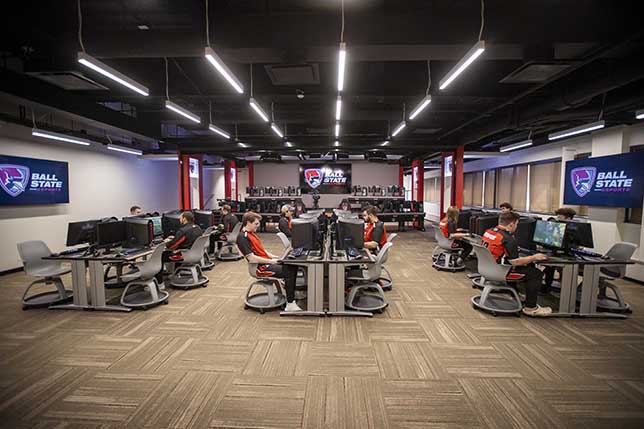
Ball State University, located in Muncie, Ind., held a virtual ribbon cutting for its new Esports Center this week. The 3,600-square-foot facility will serve as the home of the College of Communication, Information, and Media’s new Esports program.
Becker College, a small private college with campuses in Worcester and Leicester, Mass., announced on Monday that it will shut down at the end of the academic year. The college’s permanent closure is due to financial difficulties exacerbated by the COVID-19 pandemic.

The University of Pennsylvania in Philadelphia, Pa., is in the process of revamping its outdated biomedical library into what a press release calls “an open center for cross-disciplinary learning, prototyping, and collaboration.” The university is working with Voith and Mactavish Architects LLP (VMA) to finish the renovations by June 2021 and open the building to students for the fall 2021 academic semester.
vFairs, a hybrid and virtual event platform, will be offering its services to public schools, colleges, and universities as the second graduation season of the COVID-19 pandemic draws closer.

Solar panel arrays that cover canals and other waterways—also known as floating solar farms—have become an increasingly intriguing possibility as sustainable energy practices gain momentum. Researchers from the University of Stirling in Stirling, Scotland, and Lancaster University in Lancashire, England, have finished the first detailed model of floating solar installations’ environmental effects on the bodies of water they cover.

A student-driven initiative at Colorado State University has added almost 114 megawatt hours of clean electricity to the Fort Collins-based university's annual solar generation. The purchase of an 80-kilowatt, $100,000 photovoltaic solar array was funded almost entirely by student fees allocated through the Associated Students of Colorado State University (ASCSU), beginning in 2019.
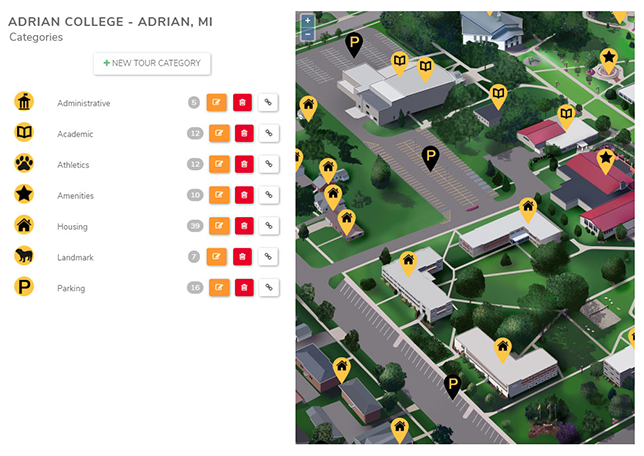
A higher education technology company with a content management system has bought another company that produces online campus maps. Modern Campus, which produces Omni CMS, has acquired nuCloud, which develops customizable, interactive campus maps and virtual tours.
San Jacinto College, located in the metroplex area of Houston, Texas, has announced plans to add solar electricity arrays to two of its buildings. The arrays, designed and installed by Sunfinity Renewable Energy, are set to lower the school’s utility costs by millions and contribute to better air quality in the area.
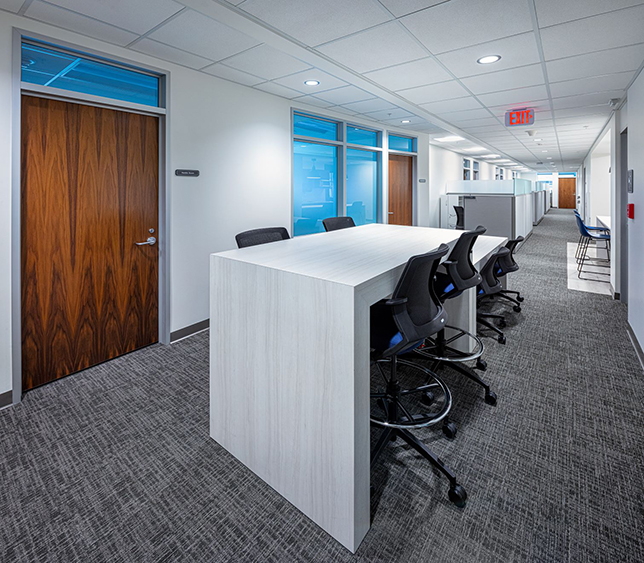
KWK Architects recently completed a design and renovation project for the Washington University School of Medicine’s Department of Psychiatry at Renard Hospital in St. Louis, Mo. The 1950s-era hospital’s second, third, and fourth floors were renovated to centralize the department and provide office and teaching space.

Two Minneapolis contracting firms recently partnered to make some long-needed repairs to the University of Minnesota’s on-campus boathouse.
Baker Technical Institute, a technical college whose main campus is in Baker City, Ore., announced this week that it’s opening a second location in Prineville, Ore., about 200 miles west. The institute will open next month to provide career and technical training to Central Oregon residents to meet the needs of skilled labor in the area.
California community college Merced College has partnered with Johnson Controls to upgrade the campus infrastructure and target deferred maintenance problems. In an effort to improve sustainability and the student experience on campus, Johnson is set to manage the design, procurement and installation of energy-efficient central plant and lighting retrofits, as well as upgrade campus building automation systems (BAS) and mechanical systems.
Michigan State University has partnered with pathogen control technology vendor UV Angel to install UV Angel Clean Air units around the MSU campus. They have already been added to busy areas like the Olin Health Center and Wonders Hall, and they’re scheduled for installation soon in campus athletic facilities. The goal is to foster cleaner, safer environments for students and faculty as they return to campus during (and after) the coronavirus pandemic.
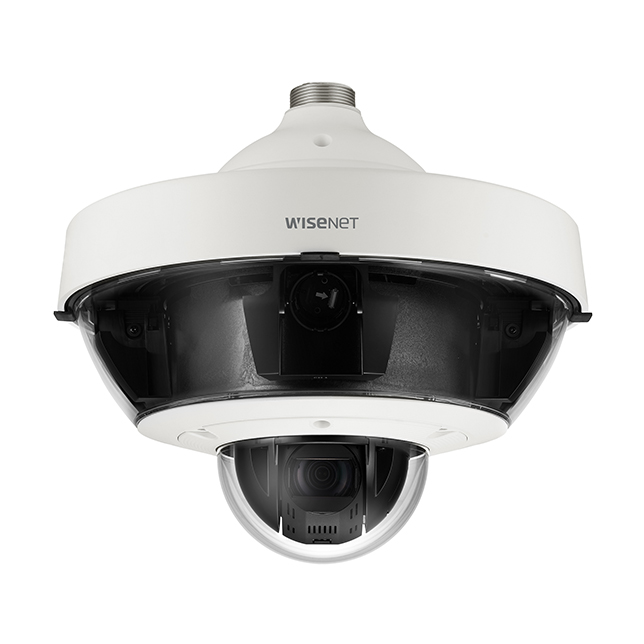
Hanwha Techwin, producer of IP and analog video surveillance solutions, has expanded its line of multi-sensor cameras that include the Wisenet 7 chipset.
The Movo WebMic HD Pro launched on Kickstarter on March 1 and reached its target goal of $15,000 by the next day. The product combines an HD web camera, a condenser microphone, and an LED ring light into one device for what a press release calls an “all-in-one” solution for video conferencing needs on any platform.
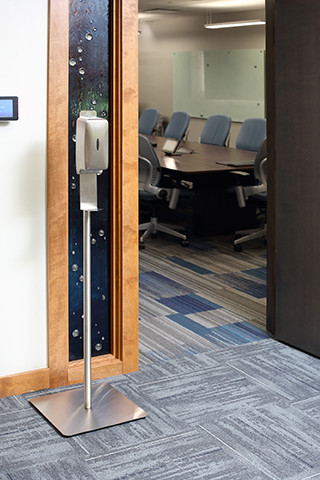
The Bradley Corp., based in Menomonee Falls, Wis., has released a new series of stainless steel hand sanitizer dispensers and stands for quick, convenient access to hand-cleansing products. Touch-free and resilient, the commercial-grade dispensers can be placed in high-traffic areas like doorways, stairwells, lobbies, cafeterias, and more.
Sacred Heart University, located in Fairfield, Conn., has officially broken ground on the construction of a $70 million ice arena to be located in west campus. The arena continues a multiyear expansion program that aims to foster personal development, student growth, and student engagement, says SHU President John J. Petillo.
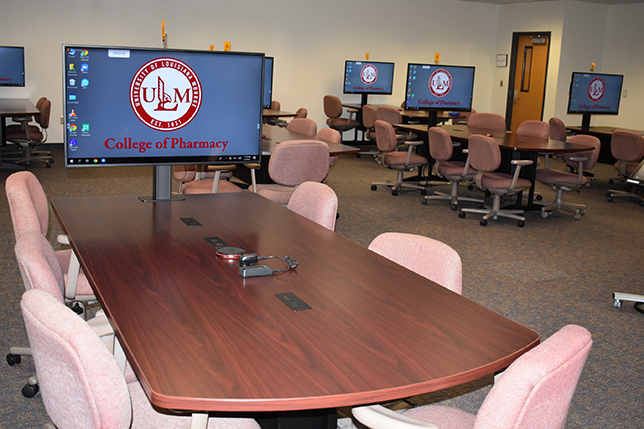
The University of Louisiana Monroe has partnered with Trox, an education technology solutions company, to install a state-of-the-art active learning classroom for its College of Pharmacy. The classroom is the first of its kind in the state, and it provides opportunities for more active participation, interaction, and collaboration among teachers and students.
Ivy League research institution Dartmouth College, located in Hanover, N.H., has selected WootCloud’s HyperContext Security Platform to provide device security and next-generation access control across the entire campus.
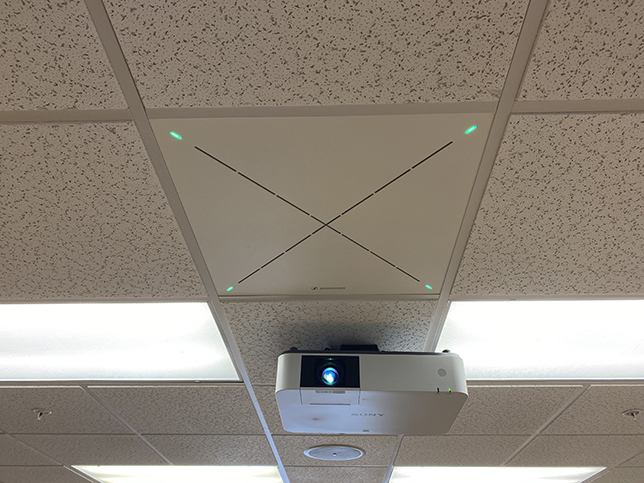
An effort at the University of South Florida has resulted in nearly a hundred classrooms being readied for simultaneous remote and in-person learning. The updates included installation of touchless sound systems and dual cameras.
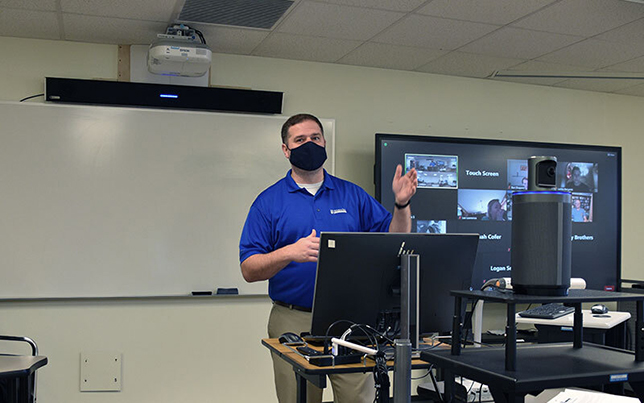
Athens State University, located in Athens, Ga., recently installed Nureva HDL300 audio conferencing systems in almost 30 classrooms on campus.
North Carolina State University is partnering with KWK Architects and Jenkins-Peer Architects for Phase 4 of its five-phase Greek Village Master Plan. Infrastructure work is in progress for a new apartment building and two new townhouse units.

Federal energy regulators have given Oregon State University permission to move forward with PacWave South, an offshore wave energy testing facility.
Many universities around the country have designated certain campus residence halls as temporary housing for students in coronavirus-related quarantine or isolation. And some universities are starting to see these spaces fill up quickly.

The Mohawk Group has announced the expansion of its Luxury Vinyl Tile (LVT) line, Living Local, with four new styles.

Quadient has become the second-largest provider of parcel locker solutions worldwide after it reached 13,000 installation sites and more than 600,000 lockers overall during FY2020. During the first nine months of the fiscal year, which ended on Jan. 31, 2021, the company reported a 78% increase in the number of packages delivered to its smart lockers.

The University of Toledo just received a five-year, $12.5 million grant from the U.S. Air Force to develop flexible solar cell sheets for space. The photovoltaic energy sheets will be used to collect solar energy for powering Earth-based receivers or other orbital or aerial instrumentation, such as communications satellites.

Daytona State College’s Palm Coast campus is set to begin a $4.2-million renovation project that will allow it to expand its nursing program. The college has partnered with DLR Group and Charles Perry Partners, Inc., on the construction that will create teaching facilities to fit an additional 90 nursing students.
Mohawk Group, a producer and distributor of commercial flooring, announced in a press release that all of its design studios and commercial showrooms are set to receive a WELL Health-Safety Rating, as determined by the International WELL Building Institute (IWBI). Mohawk is among the first flooring manufacturers to meet this standard.

The University of Wisconsin-Platteville has received approval from the state to erect a 2.4-megawatt solar array on its campus. According to the university, this will be the largest solar array owned by a Wisconsin state agency and will make the campus the sixth-highest on-site producer of renewable energy in the country among institutions of higher education.

Faulkner University in Alabama is creating a new College of Health Sciences out of a former Burlington Coat Factory building. The work began last summer, after university President Mike Williams announced the planned conversion of a 13-acre shopping center and the empty Burlington building into a facility that would house all of Faulkner’s health science programs.

A project to reconsider how space was used for medical education that began six years ago is progressing at the Washington University School of Medicine in St. Louis. KWK Architects has repurposed a 7.8-acre industrial site and warehouse off-campus into new office space for the school.