Technology is modernizing the traditional instructional environment. The modern college student arrives on campus with more than just a suitcase in tow. An array of gadgets will also be on hand, including a tablet computer, a smartphone, an MP3 player, perhaps a laptop.
Communication is key, especially during emergencies. Technology can help spread the word.
Collaborative learning involves teamwork, as does the designing of environments in which collaborative learning can thrive. Educational facility design experts know what works - and what doesn't - when it comes to creating collaborative spaces that allow for multiple uses and accommodate multiple learning styles. When creating collaborative spaces, keep the following in mind.
As with other campus spaces, fostering collaboration is a decisive influence in the design and function of todays campus libraries.
New beginnings for College Planning & Management. In addition to the magazines that many of you have come to depend on, over the next few months you will notice the expansion of our brand.
New York's Nyack College has a plan in place to retain adult students.
Being organized and planning ahead can improve the bottom line.
Affordable new access control technologies are changing the way students get into college buildings.
Keeping historically significant facilities weatherproof and energy-efficient while preserving architectural features takes care and planning.
Here are five metrics for establishing and tracking performance and customer satisfaction in your outsourced campus services.
For the past decade, fire safety programs on college and university campuses have focused on keeping students safe while in campus residence halls and fraternity and sorority houses, buildings that are often most at risk. While from a numbers standpoint, campuses are relatively safe from the effects of fire, there are a number of small, too often deadly, fires in student housing on campus generally caused by student carelessness. There are a number of ways to enhance student fire safety.
Today, in college classrooms, instead of the silence of students taking notes in notebooks, one may hear the soft tapping of laptop keys. Technology in the classroom has been evolving at a rapid rate, leaving teachers and students sometimes running to keep up. Multimedia technology, which specifically refers to technology related to audio and video, is no exception.
Something old, something new? That may work great in weddings, but how about campus renovations? In constructing new buildings, assuring good indoor environmental quality (IEQ) is a basic consideration. But when it comes to renovating older facilities, special efforts must often be taken to apply modern standards in acoustics, daylighting, thermal comfort, and air quality.
The days in which a professor stands at the front of a huge room and simply delivers a lecture while students dutifully listen and take notes are disappearing. Todays students and educators demand far more interaction and flexibility. Thoughtful facility design can help colleges and universities meet these expectations.
Darrell Smith, executive director of the International Window Film Association, speaks with College Planning & Management concerning the uses and benefits of window film for new and existing campus facilities.
Despite the fundraising challenge that confronts any two-year, private college, the ensuing capital campaign for Spartanburg Methodist College (SMC) proved successful and led to Ellis Hall being built and dedicated last November (2012). The facility was the first new academic building on the 110-acre campus since 1967. The 48,000-sq.-ft. building increased the College’s academic space from 15 to 29 percent of the total physical plant. SMC’s seven student residence halls account for most of the balance. SMC’s administration can focus next on upgrading existing buildings.
While increased enrollment is widely regarded as a positive development, understanding ways to manage the influx of additional students, providing a high-quality educational experience, meeting academic goals, and staying within budget requires administrators and architects to minimize new construction and maximize existing space.
As architects and designers we are uniquely able to incorporate sustainable strategies into all of our projects, regardless of whether or not the project will be filed to achieve third-party certification. Sustainable strategies can be incorporated into any project through passive strategies, mechanical systems, and finish and furniture selection.
The congested college and university marketplace means that every presidential communication must further institutional branding and messaging. Contemporary presidents are the public “face” of the institution, and competition for audiences’ attention has never been fiercer.
As colleges and universities focus on strategies to make their campuses more sustainable, they are increasingly turning to green flooring products such as carpet tiles. While many schools are still installing traditional broadloom carpeting, they are using carpet tiles on floors that were once covered with vinyl or other hard surfaces, such as those in classrooms.
Reducing energy consumption is hugely beneficial, and nearly everyone is practicing good kW-cutting habits. But the second most direct route to decreasing energy costs is often overlooked: managing the energy purchase itself. The largest barrier to purchasing energy at lower prices: understanding the deregulated energy markets.
When you consider student recreation centers through their history, the desire for their services and programs has always come from students,” says Pam Watts, executive director of Corvallis, OR-based NIRSA: Leaders in Collegiate Recreation. “It is that desire that results in facilities. In addition, the rec center is going to continue to be an important part of campus life as more and more employers ask higher education to develop soft skills in addition to hard skills.”
Sure, it’s easy to toss trash into the proper receptacles and to turn off the lights when leaving a room, but how does a university with thousands of personnel, administrators, and students on campus initiate a greener place to live, work, and study? Green initiatives for the higher education sector are everywhere, and there are so many ways that colleges can get involved, from implementing cleaner technologies that use less power consumption to offering vegan dining choices in the cafeteria to properly disposing of old, outdated printers.
While the nonstop, point-grabbing treasure hunt for Silver, Gold, or even Platinum certification has forced architects to get better at designing and creating more efficient structures, everything outside the building envelope has basically remained an afterthought. This narrow approach not only downplays the complex role a project’s site plays in its overall sustainability, it also ignores cultural and contextual considerations that are critically important to campus planning and design. Thankfully, there could be help on the horizon with the long-overdue introduction of the Sustainable Sites Initiative (SITES) into the certification game.
In an age when digital has become such a key channel, the colleges and universities that embrace this concept will outpace those that don’t. It’s not a financial question anymore, a bifurcation of the haves and have-nots; it’s more of a mindset issue. While having the vast resources of a major institution certainly helps, it doesn’t matter how much money you throw at a website project if it’s not seen as the central hub of your overall communication efforts. And if it isn’t used as a chance to engage an inclusive set of stakeholders from across campus, it’s a huge opportunity missed.
Unity College in central Maine is a small liberal arts college with a big voice in the national sustainability conversation. We take seriously our leadership role in higher education and across sectors, preparing our students for leadership roles of their own in a changing world. From our unique sustainability science focus throughout the curriculum, to our first-in-the-nation commitment to divest our endowment from fossil fuels, we aim to model viable approaches to sustainability education that improve learning, engage the community, and decrease environmental impact.
Information technology is a highly dynamic, rapidly evolving sector. So are the risks and threats that surround it, and the functions it provides for our institutions. Effective risk management is essential.
Higher education has already taken a leadership role in climate mitigation — that is, preventing climate change by reducing greenhouse gas emissions — as displayed by the 660 signatory campuses of the American College & University Presidents’ Climate Commitment (ACUPCC) who have collectively reduced net carbon emissions by 25 percent in just five years. Now, higher education must take the lead in climate adaptation — preparing for and responding to the impacts of climate change.
For 17 years, Studio 804 has pioneered new technologies and advanced construction techniques to produce one building per year, including four LEED Platinum projects completed to date and two additional projects pending LEED Platinum certification. The studio operates out of the School of Architecture, Design, and Planning’s 67,000-sq.-ft. East Hills shop and fabrication facility, just outside Lawrence. The facility allows for much of the design to be prefabricated, an asset to each project’s intense schedule. It is through the support of organizations and individuals committed to environmental stewardship that Studio 804 is able to continue its service to the community and educate the general public through the use of innovative technologies.
Everybody loves the idea of creating a clean, green world and passing that world on to future generations. People recycle competitively, monitor energy usage dashboards, and approach LEED certification with gusto. Security, on the other hand, is reactive. Most individuals don’t really consider it until an event brings safety to the forefront. Yet both must co-exist on today’s college campuses even though they may be at odds.
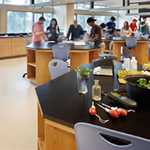
Increasing demands for high-performance and sustainable designs are challenging laboratories and research facilities to consider their energy and water usage. Laboratory design is constantly evolving and outdating previous methods due to new building and energy codes, and lab designers are seeking game-changing ideas. This makes innovative design solutions more imperative than ever.
As of April 4, 2013, there were 665 signatories to the American College & University Presidents’ Climate Commitment. Sustainability efforts on campus have become essential as college hopefuls are now adding a “green campus” to their selection criteria!
Regardless of the factors driving the continued market focus on environmentally sustainable construction strategies, we have noted some recurring trends that continue to be popular. The following sections will briefly note each of these trends and some of the unique opportunities of their implementation.
Given that an investment in a LEED building is 40 to 50 years or longer, a related investment in management and maintenance will also run for many decades. Unfortunately, maintenance is often not adequately considered in advance, and when budgets tighten, deferring building maintenance can seem like an attractive option to universities who are trying to stretch their dollars. So how does a cash-strapped public institution pay for green construction and maintenance?
Longwood has practiced sustainability by heating with biomass fuel (sawdust) for over 30 years. Longwood is the only public institution of higher education in Virginia and one of only two state agencies that burns biomass for heating fuel. Current annual energy savings are more than $4.9M when compared with burning oil, which the University used as its fuel source before switching to biomass.
So, why have smart campuses found sustainability such an attractive value proposition? In short, because our customers are demanding sustainability, because it saves money, and because higher education’s ethical license to operate is at risk if we don’t respond to a society beset with myriad unsustainable ailments.
The $5.6M Gaillard Hall restoration/rehabilitation marks the final project in a $69.85M, two-phase public/private venture that included six additional new structures and a cadet formation plaza, all designed by LAS. Gaillard Hall and two of the new residential buildings — Patriot Hall and Liberty Hall — are organized around the formation plaza to create a military education precinct in the heart of the campus of what is now the University of North Georgia. Nestled in the foothills of the Appalachian Mountains, the University is one of only six senior military colleges in the U.S.
What does “loud enough” mean in terms of a typical classroom? For the purposes of understanding classroom needs, we can begin with an interpretation. “Loud enough” is an attempt to describe the volume of one signal in comparison to others. This effectively means that whatever is being listened to (i.e., the signal) should be louder than the “noise” in the room.
Two successful managers share their advice for taking your custodial services from better to best in terms of getting the job done and keeping the customer satisfied.
Many smaller liberal arts institutions don’t even have secondary server rooms as backups. If an earthquake or flood destroys the single primary server room on campus, an institution won’t be able to issue paychecks or deposit tuition payments. New students won’t be able to register. All of the data stored in the learning management system will be inaccessible to students as well as professors. School may well be over for the year. Because the results can be so dire, more and more schools are building secondary server rooms for disaster backup.