Smart Commuting
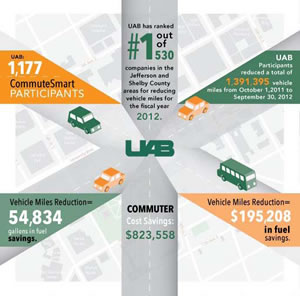
ILLUSTRATION COURTESY OF THE UNIVERSITY OF ALABAMA AT BIRMINGHAM
Lengthy commutes serve as a major stressor for a majority of America’s workforce. In an effort to combat these time-consuming treks, many employers and organizations are turning to programs like CommuteSmart to combat problems associated with daily travel. CommuteSmart (www.commutesmart.org), a program of the Regional Planning Commission of Greater Birmingham, AL, implemented to reduce traffic congestion and improve air quality in Jefferson and Shelby Counties, works with companies, organizations and institutions to develop tailored employee commute options including ride matching, carpool, walking, biking, teleworking and vanpool services.
In 2007, the University of Alabama at Birmingham (UAB) began using CommuteSmart as a way to enhance the overall health and wellness of their employees.
“Making smart lifestyle choices is a key focus of our employee wellness program,” says Alesia Jones, chief officer of UAB Human Resources. “Like making a conscious decision to eat better or exercise more, the decision to take CommuteSmart is another way to make a positive impact on our environment.”
Successful Results at UAB
The university joined other Jefferson and Shelby county companies — today totalling 530 — already using CommuteSmart. The use of the program spread rapidly across campus, and in 2013, UAB was named number one in reducing vehicle miles amongst all Jefferson and Shelby county participants.
The 1,177 UAB employees registered with CommuteSmart reduced a total of 1,391,395 vehicle miles between Oct. 1, 2011, and Sept. 30, 2012. This equates to saving 54,834 gallons of fuel, as well as $195,208 in fuel savings, according to CommuteSmart.
Commuters also saved on other costs like vehicle maintenance — this helped them altogether save an estimated $823,558. For Matt Windsor, manager of UAB Publications and Periodicals, the benefits of the CommuteSmart program were more than just monetary.
“It (the commute) was essentially taking up two hours of my day,” he says. “I had to find a way to get some of that time back.”
Windsor mentioned his need to find someone to carpool with him to fellow co-worker Jo Lynn Orr (now retired), who carpooled with two others. She had signed up with the CommuteSmart program several years previous and suggested Windsor look into the program as a possible solution.
Windsor did just that and soon connected with Darlene Calfee, a registered nurse at the Veteran’s Affairs Hospital. She offered him an opportunity to ride with her vanpool to see if it was something that would fit his needs. Windsor was happy with the experience and now is part of the UAB Employee CommuteSmart Program.
“It’s given me back those two hours I was missing,” he says. “I can do work, read, nap — whatever. It’s also a lot less stressful. I find when I get home that I feel much better. And because we get here early in the mornings — usually just after 6:30 A.M. — and leave at 4 P.M., I’m home a little earlier in the evening, and I get to spend more time with my wife and kids.”
“There’s no doubt the money I will save is an added benefit,” Windsor says. “I’m probably saving up to $100 a month when you figure in parking and gas. I’m also not putting the 60 miles a day I was on my car, so I should save money on oil changes and tires.”
Image Enhancement
Dedicated CommuteSmart users like Windsor have helped UAB to win recognition as a school that cares about its employees and the environment. Using the program does not only mean fuel and cost savings; CommuteSmart said UAB employees’ participation has taken single-occupied vehicles off the road and reduced traffic congestion. This contributed to Birmingham reaching “attainment” status with the six primary air quality standards for the first time in 30 years.
“Using CommuteSmart fits into the overall goals of UAB,” explains André Davis, director of UAB Parking and Transportation. “We try to be a green campus by practicing sustainability and efficiency as much as possible, and this helps to support that initiative.
Davis says he is encouraged to see so many employees participating, and he would like to see the amount grow in the future.
This article originally appeared in the College Planning & Management August 2013 issue of Spaces4Learning.