Energy Saving Retrofit
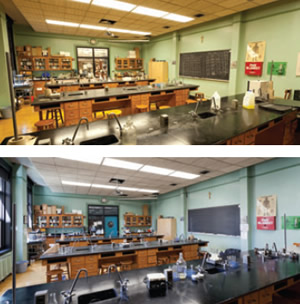
Before and after the retrofit.
Energy savings have long been important at Regis High School, a tuition-free Jesuit college preparatory school for young men in New York. This drove school leadership to choose Seesmart Technologies, Inc. when it came time to retrofit more than 2,500 fluorescent lights throughout the school.
Regis’ estimated LED retrofit benefits include significant energy savings of more than $36,000 and over 116,000 kilowatt-hours per year with a carbon footprint reduction of almost 120,000 pounds per year. Additionally, the preparatory school received a $32,000 rebate from Con Edison.
“Here at Regis, we pride ourselves in fostering a spirit of generosity and service, so decreasing our carbon footprint was an obvious decision for the betterment of our neighborhood,” says Father Judge, president of Regis High School. “This project was a big step toward setting a good example for our students and the community as it solidifies our commitment to a more sustainable future.
Seesmart’s retrofit for Regis High School began by replacing the light fixtures in the gymnasium with LED fixtures. After seeing the results in the gym the administration decided to replace all of the school’s lighting with LED fixtures. Fluorescent lights were replaced with Seesmart LED tube lighting in over 100 classrooms, offices, and other educational spaces, as well as extensive hallways. The changeover included 967 new or retrofitted fixtures.
Father Judge says, “Since 2006, Regis has been an educational leader in ‘going green’ which can be seen by our 22 kilowatt solar panel array on the roof, a 22,000 square-foot green roof installation, as well as other sustainable efforts. Committing to an entirely LED facility with the help of Seesmart was the next step in our efforts to further decrease our carbon footprint.”
www.seesmartled.com
This article originally appeared in the issue of .