Underground In Missouri
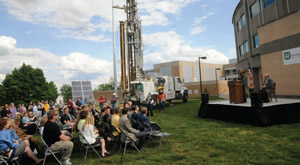
PHOTO COURTESY OF MISSOURI UNIVERSITY OF SCIENCE AND TECHNOLOGY
DIGGING IN FOR ENERGY SAVINGS. The Missouri University of Science and Technology broke ground on a geothermal energy project during the week leading up to Earth Day in the spring of 2012. With the large-scale project almost complete, the Rolla, MO-based school is expected to reduce carbon dioxide emissions on campus by 25,000 tons a year while cutting annual energy use in half. The system includes approximately 600 wells with pipes creating closed geothermal loops serving three campus geothermal plants.
An unconventional, green approach to Missouri University of Science and Technology’s energy challenges, the Geothermal Energy Project, is the most comprehensive initiative of its kind in higher education.
Geothermal energy is heat derived below the earth’s surface that can be harnessed to generate clean, renewable energy. This vital, clean energy resource supplies renewable power around the clock and emits little or no greenhouse gases — all while requiring a small environmental footprint to develop.
When completed next year, the Missouri S&T Geothermal Energy Project will supply energy to 15 campus buildings and the campus chilled-water system, which serves much of the Rolla, MO-based university.
Initially, the system is projected to save more than $1 million in energy and operational costs annually. That savings is expected to grow to $2.8 million annually in future years.
The system will include approximately 600 wells with pipes creating closed geothermal loops serving the three regional campus geothermal plants. Each of the three plants will contain heat pump chillers, supplemental cooling towers and gas-fired boilers to provide geothermal energy to surrounding areas of campus. The benefits of regional plants include less equipment to maintain, running geothermal water only to the regional plants, longer equipment life of screw chillers compared to modular type, and taking advantage of load diversity between buildings.
To reduce piping costs and simplify phasing and growth of the geothermal campus system, each regional plant will be tied to a dedicated well field. (The well fields will not initially be connected to each other, but the university will have the option to connect them at a later date.) The well fields will be sized to optimize the payback from utility cost savings.
Missouri S&T’s World War II-era power plant, which has provided energy to much of the campus for nearly seven decades, is powering down as the university makes the transition to a geothermal energy system. The power plant, which was constructed in 1945, burned coal and wood chips to provide steam to much of campus for the past 69 years. The plant’s boilers were permanently shut down in May.
When completed, the geothermal system is expected to cut the university’s annual energy use by 50 percent and reduce its carbon footprint by 25,000 metric tons per year. That reduction amounts to roughly the equivalent of the greenhouse gas emissions of 4,600 passenger vehicles each year. The geothermal system will also reduce Missouri S&T’s water usage by over 10 percent, or 10 million gallons per year, and eliminate a $34-million backlog in deferred maintenance costs for the aging power plant.
The geothermal project was approved by the University of Missouri System Board of Curators in 2010 and funded through the sale of bonds by the university. The university plans to repay the debt over 30 years through savings from the project.
UNDER CONSTRUCTION SINCE 2012
Construction of the geothermal system began in May 2012 with the drilling of groundsource wells around campus. Pipes were installed in the wells and connected to create closed geothermal loops dedicated to each of the plants. “Those plants produce and export heating water to campus buildings through a new heating hot water distribution system and produce and export chilled water for cooling through a reconstructed chilled water distribution system,” says James Packard, director of facilities operations at Missouri S&T.
The system allows energy to be stored in and reclaimed from well fields around campus. Approximately 790 wells will serve the geothermal plants.
Standalone equipment will be housed in the remaining campus buildings that were heated by steam from the power plant. Physical facilities staff and contractors installed heating, ventilation and air conditioning systems in campus buildings over the summer, Packard says.
Campus buildings that are not in the scope of the geothermal heating system under this project that currently receive steam from the power plant will be retrofitted with dedicated steam boilers until those buildings can be added to the future geothermal plants.
For more information on Missouri S&T’s Geothermal Energy Project, log on to geothermal.mst.edu.
This article originally appeared in the issue of .