Phipps Conservatory and Botanical Gardens
Project Snapshot
PROJECT: Healthy Sustainable Classrooms
LOCATION: Pittsburgh, Pa.
COMPANY NAME: Mohawk Industries
WEBSITE: www.mohawkind.com
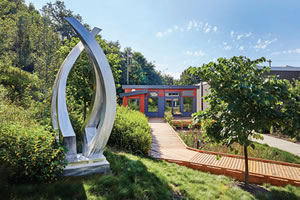
The SEEDclassroom: Classroom of the Future Stresses Sustainability and Healthy Students SEEDclassrooms are a healthy and sustainable alternative to standard portable classrooms. These modular, hands-on learning spaces conform to Living Building Challenge standards, and their exposed systems make them the ultimate teaching tools. Phipps Conservatory and Botanical Gardens in Pittsburgh, PA, recently completed a SEEDclassroom with red list-free carpet tile by Mohawk Group. Not only is the carpet a highly sustainable product, but students even helped design the flooring layout as part of learning about healthy spaces. Mohawk Group flooring offers multiple solutions in the SEEDclassroom, calling attention to the importance of healthy learning environments.
THE CHALLENGE
Standard portable classrooms provide quick solutions for expansion but rarely offer adequate natural light or ventilation and may contain materials with high levels of toxins. “SEEDclassrooms are a space solution with a positive learning impact,” says Stacy H. Smedley, co-founder of the SEEDcollaborative and preconstruction manager and sustainable initiative lead for Skanska USA Building. “We want to find ways to educate and inspire students to see the importance of sustainability and the role buildings can play in our lives, while also providing the classroom space needed.”
THE SOLUTION
The SEEDclassroom at Phipps and one under construction in D.C. use flooring by Mohawk Group, which has dedicated the last decade to leading the building product manufacturing sector in sustainability and transparency. “Mohawk’s vast inventory of red list-free products is why we were selected to be part of this important and exciting initiative,” says Rochelle Routman, Mohawk’s vice president of sustainability. The International Living Future Institute compiles the “red list” of harmful chemicals as part of the Living Building Challenge, a rigorous building certification program to which SEEDclassrooms adhere.
IMPACT ON LEARNING
According to Routman, “The carpet tile used in the Phipps SEEDclassroom — Lees Sequences II Collection — is one of more than 490 Mohawk products that are red list-free. Sequences II also features EcoFlex NXT, which is a PVC-free backing that is lighter than similar PVC products. This makes the tile easier to install and reduces the carbon footprint in shipping.” The Phipps SEEDclassroom shows students what a healthy space looks like. Students even helped design the floor — they wanted it to look like water, explains Smedley, “So we used carpet tiles with the colors of water to create a beautiful landscape on the floor. With Mohawk, we have a custom carpet that we know is healthy for students.”
Editor’s Review
The U.S. Department of Education’s report, “A Summary of Scientific Findings on Adverse Effects of Indoor Environments on Students’ Health, Academic Performance and Attendance,” states that there is evidence poor environments in schools due to the effects of indoor pollutants adversely affect health, performance and attendance. By using red-list-free carpet tiles, the designers helped ensure that everyone in the SEED classrooms would remain healthy.
Also, by including the students in the design process and using appropriate colors, etc., the school decision makers have done their best to provide an environment that should enhance student achievement, teacher effectiveness and staff efficiency.
This article originally appeared in the issue of .