Lighting Upgrade Leads to Big Savings
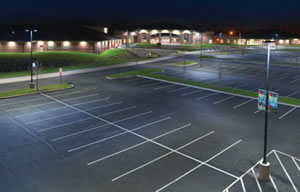
Toledo Public Schools realized a large energy savings
by switching to Cree lighting, which also led to a large
financial savings.
The Toledo Public
School’s (TPS) Maintenance
and Operations Department
supports 42 schools. As the director of
Maintenance and Operations, Quintin
Reynolds is responsible for finding new
ways to save energy. Reynolds along with
key staff member, Ron Miller, and TPS’s
energy consultant, Palmer Conservation
Consulting, worked to save energy by
replacing 2,553 outdoor metal halide and
high-pressure sodium lights with Cree LED
luminaires.
The Maintenance and Operations
Department with Palmer Conservation
Consulting chose Cree LED lights because
of the product longevity, low maintenance
and the 10-year limited warranty.
“Cree had a 10-year warranty when everyone
else offered seven years or less,” says
Miller. “The lighting quality is there and the
fixtures are good quality — well built.”
“TPS likes the performance, price
point, and how it looks compared to other
lights on the market,” adds Ron Miller. “In
addition, the lighting enhanced the look of
the schools. The luminaires come in many
colors so we could choose colors to complement
the architecture of each school.”
The crisp, white light of Cree’s luminaries
can create a safe atmosphere for students,
administrators and visitors. As important,
the Cree luminaires are backed by Cree’s
10-year industry-leading limited warranty,
providing investment protection. By upgrading
the outdoor lighting at all 42 schools with
Cree LED luminaires, TPS reduced energy
consumption by 2.8 million kWh .
Looking at Start High School, Cree is estimating
that they will see a 69-percent energy
savings based on watt reduction. Since Cree
LED lights are virtually maintenance-free
for 10 years, TPS expects a lifetime savings of
$125,072 on maintenance costs by not having
to send staff and trucks out to replace bulbs.
Energy and maintenance combined, the savings
equates to a 1.8-year payback period.
www.cree.com/lighting
This article originally appeared in the issue of .