Synchronized Timekeeping Solution
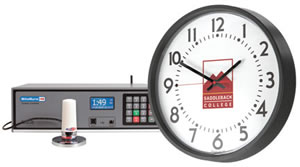
Saddleback College relied on American Time’s SiteSync IQ to synchronize clocks around the campus and ensure that classes, events and meetings started on time.
Saddleback College in Mission Viejo, CA, sits on 110 acres of rolling hills and serves more than 26,000 students. To keep students, faculty and staff on time, it relied on a wired clock system that was installed years ago when the campus was one-third the size of what it is today. With the expanded acreage and additional buildings, the college did not have consistent or accurate synchronized time.
Without clocks that displayed the same precise time, meetings and classes often started at varying times. Or participants would unknowingly arrive too late or too early. Saddleback College sought a synchronized timekeeping solution that would keep every clock in every building on the exact same time — down to the second.
The school selected the American Time SiteSync IQ wireless clock system using CDMA (code division multiple access) to synchronize time, along with a 40-watt controller and a combination of hard-wired and battery-operated clocks.
Saddleback College’s synchronized timekeeping solution can wirelessly synchronize and control any device with a signal circuit. The CDMA sync option allows SiteSync IQ to receive a time signal from a nearby cell phone tower, so there is no outside cable or wire installation needed. Saddleback College has guaranteed signal coverage with one transmitter, 100 percent FCC compliance, and pinpoint accuracy to NIST, the official world time. The school now has approximately 450 American Time clocks across campus.
“We have one signal that feeds the entire campus and our campus is very hilly. But we’ve never had an issue with anything,” says Jerry Doolittle, lead electrician at Saddleback College. “The clocks keep up automatically with daylight saving timing changes and they free up a lot of our maintenance staff’s time. No one notices the clocks anymore and that’s a good thing.”
www.american-time.com
This article originally appeared in the issue of .