Road Art That Lasts
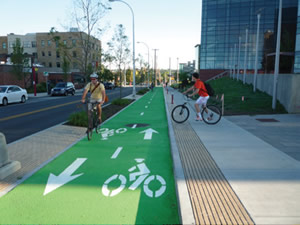
Syracuse University used Transpo Industries’ Color-Safe MMA Pavement Marking as a central part of their Connective Corridor project.
Syracuse University has been a staple in the City of Syracuse, NY, since 1870 and has always stayed at the forefront of continuous infrastructure innovation. Maintaining the state-of-the-art campus extends to their transit and transportation system, and to that end university officials and students created the “Syracuse Connective Corridor” project. This project set forth a goal, among others, to implement bike paths throughout the university, as well as connecting to the city. However, with the continuous university and city traffic coupled with the staggering winter weather conditions frequently seen in Syracuse, project officials were faced with an issue: finding a pavement marking material that would provide maximum durability while still maintaining the campuses beauty and offer maximum safety for cyclists.
For this they turned to Transpo Industries’ Color-Safe MMA Pavement Marking. Color-Safe is a new generation Methyl Methacrylate (MMA) resin component designed specifically for projects such as the Connective Corridor.
Color-Safe is easily distinguishable by its uniquely bright and resilient colors, a feature that fit in seamlessly with the university’s need to maintain the campuses famous scenic appeal.
Fitting with the university’s desire for eco-friendly practices, Color-Safe’s implementation uses minimal emissions of volatile organic compounds (VOC). Since it is also one of the longest lasting pavement markings available, Color-Safe also ensures minimal construction materials waste. Unlike thermoplastic paint, which is frequently used and needs to be reapplied every 6-12 months, MMA materials can last up to 10 years.
Finally, Color-Safe was designed to be extremely easy to apply, as well as fast curing in a wide variety of temperatures. For university officials, this meant minimizing labor cost as well as ensuring the bike lanes would be up and running with nominal road closures.
www.transpo.com
This article originally appeared in the issue of .