UW–Madison Announces Completion of Morgridge Hall
The University of Wisconsin–Madison recently announced that construction is complete on Morgridge Hall, a new academic building, according to a news release. The facility opened September 3 at the start of the fall semester, consolidating the School of Computer, Data & Information Sciences into a single facility for the first time.
Designed by Kahler Slater and LMN, the building houses computing- and data-related disciplines and brings together three of the university’s fastest-growing majors. The project was supported by alumni John and Tashia Morgridge.
The facility is organized around a central atrium that serves as the primary circulation and gathering space. The building is structured into three program areas—learning, student and research spaces—connected vertically through shared common areas. Each floor includes research labs, offices and collaboration spaces intended to support interdisciplinary work. Amenities include a ground-floor café, informal meeting areas, wellness rooms and outdoor terraces.
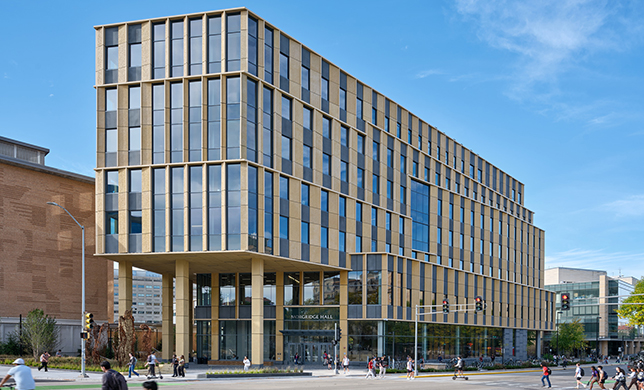 Photo courtesy of Kahler Slater
Morgridge Hall incorporates several sustainability features. The building includes 359 rooftop solar panels projected to generate 162,441 kilowatt-hours annually, an amount the university says is equivalent to the electricity use of 182 average Wisconsin households. The project is targeting a 63% reduction in energy use compared with a 2030 baseline. Water use is designed to be 35% below the federal standard, and a stormwater capture system will support irrigation.
Landscaping and green infrastructure are integrated into the site. Planted areas cover 25% of the site, including a courtyard, terraces and a green roof. Of the plant species used, 82% are native to Wisconsin.
University officials describe the building as a central hub for research, education and outreach in technology-related fields.
“Morgridge Hall redefines what an academic building can be—uniting data, computation, and information sciences in a vibrant, sustainable environment that fosters collaboration and discovery. Every aspect of the design, from the daylight-filled heart at its center to the flexible research and learning ecosystems, is crafted to spark interdisciplinary connections and support the university’s mission of socially conscious innovation while producing and attracting top talent to the region,” said LMN Principal Mark Tumiski. “By integrating biophilic elements, public art, and advanced energy strategies, Morgridge Hall not only honors Wisconsin’s cultural and natural heritage but also sets a new standard for environmental stewardship and human-centered design. As an intellectual lighthouse and resource for the whole university, it’s a physical realization of the ‘Wisconsin Idea’ that the discoveries made on campus must be applied for the good of all of society.”
About the Author
Matt Jones is senior editor of Spaces4Learning. He can be reached at [email protected].