Immersive Learning Environment
- By Tom Balke, Tomas Eliaeson
- 10/01/17
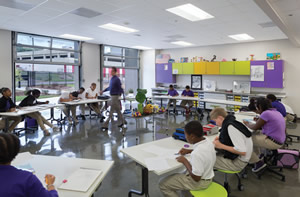 Outstanding curriculum, great leadership and inspirational teaching are the foundation to driving student achievement. The environments in which our children learn, however, have the ability to play an instrumental role in supporting and further enhancing that foundation.
Over the last 10 years, Little has been researching and investigating this new generation of learning that will prepare our children for an exponentially more creative, innovative and collaborative economy. Designing for the success of this type of learning is critical. And, now more than ever, the environments must take into consideration both the mind and the body of the students. The following offers more detail on how the organization of space and the focus on wellness can impact student achievement.
Immersive Learning
When Little first started working with Fulton County Schools in Georgia, Dr. Muri, former deputy superintendent of Academics, said, “We know how students learn and what they need to learn. Our challenge is we need environments to act upon that information to personalize and differentiate learning to each and every child.” An immersive learning environment embraces the idea that learning happens everywhere — it engages and empowers both teachers and students. For schools to experience optimum achievement, spaces must support individual students, small groups, mentoring activities and peer-to-peer learning. Some spaces should be ideal for more extroverted learners and large-group activities, others should cater to introverted students. These spaces should even accommodate different learning speeds, offering students added privacy to study at a more comfortable pace. The design should also take advantage of often-underused spaces at the ends of hallways by creating areas for serendipitous student interactions. By providing places for a small table, four chairs and a screen that can connect to a laptop, students can collaborate quickly and easily. Other spaces support public speaking with acoustic insulation and tiered seating that allows teachers and students to present or gather more comfortably for group lessons. The immersive learning concept allows students the opportunity to receive more cross-disciplinary, more active learning that helps raise engagement which leads to higher achievement.
Wellness
Often times when we talk about movement in the classroom or views to the outdoors, many people think that will lead to a more disruptive and/or distracted classroom. However, science proves differently. “Children who are more active show greater attention, have faster cognitive processing speed and perform better on standardized academic tests,” says James F. Sallis, Ph.D, with University of California, San Diego. According to Danah Telfair, Head of School, at Invest Collegiate Transform in Charlotte, N.C., “movement is huge.” The design of Invest Collegiate incorporates movement through classroom furniture, a centralized stair connecting the school’s three floors and even a spiral slide that connects the two lower floors. The focus on wellness at Invest Collegiate, however, goes far beyond movement. The design also incorporates connection to the outdoors through large windows and even classrooms that incorporate garage-type doors that open to the outdoors. Studies show that children are calmed by views of nature. It impact’s their achievement by reducing stress, improving their heart rate and helping them recharge their energy/focus. To encourage nourishment, another component of wellness, Invest Collegiate has incorporated a hands-on garden, allowing students to learn about where their food comes from, what foods are healthy, composting and even strong business acumen as students take online orders from the school community and distribute the produce during carpool.
In addition to immersive learning and wellness, integrated technology plays an important role in how design can impact student achievement. As designers, it’s important to measure and track how these strategies produce quantitative results. At Little, we are partnering with a few of our clients to track this information and hope to have these results by the end of this school year. In the meantime, you can hear from teachers and students on exactly how an immersive learning environment and focus on wellness has impacted Invest Collegiate watching this video.
This article originally appeared in the issue of .
About the Authors
Tom Balke is a studio principal with Little Diversified Architectural Consulting. He can be reached at [email protected].
Tomas Eliaeson is a director of design in Little Diversified Architectural Consulting’s Community Practice. He can be reached at [email protected].