Better Stormwater Management Made Easy
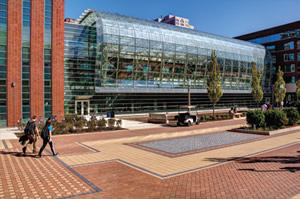
Building upon the university’s commitment to sustainability, the plaza features a storm water management system, which includes permeable pavers, native plantings, and a living-learning laboratory for students and visitors.
The Loyola University (Loyola) in Chicago, IL, has been advancing sustainability practices across the university for decades and has many accomplishments, including 10 LEED certified buildings. Their commitment to sustainability is reflected in their campus, curriculum, and culture.
As part of this initiative they have been recognized as a leader in water conservation, diverting 18 million gallons of rainwater from the Chicago sewers. Permeable pavers are an integral component throughout the campus.
When Loyola expanded its Lake Shore campus to the south, planners decided to buy an entire avenue from the city, close it to vehicle traffic, and replace the street with a wide concrete paver shared-use plaza.
This is one of the first pedestrian-only streets on the city’s far north side. The designers wanted to allow pedestrians and bicyclists safe passage between the southern areas of the school.
Building upon the university’s commitment to sustainability, the plaza features a stormwater management system, which includes permeable pavers, native plantings, and a living-learning laboratory for students and visitors. Stormwater management is a particularly important component of the campus design due to its proximity to Lake Michigan.
Unilock permeable path systems are found throughout the campus, along the St. Ignatius Plaza, the West Quad, East Quad, and CTA Station. This eliminated the need for underground storage tanks, as rainwater naturally filters back into the ground. This change from impervious asphalt to permeable paving is a more sustainable best practice for the campus. “In the past, runoff pouring from Loyola’s impervious streets and parking lots created flooding problems and sent more than six million gallons of water annually into Chicago’s storm sewer system and Lake Michigan,” wrote planner Doug Kozma, RLA, principal at Smith-GroupJJR’s Campus Planning practice.
The permeable pavers, he wrote, are part of “a remarkable stormwater management system” that is a “testament to the university’s environmental ethics.”
www.unilock.com
This article originally appeared in the College Planning & Management May 2018 issue of Spaces4Learning.