Renewable Energy Initiatives Enhance Campus
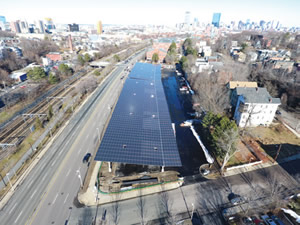
Roxbury Community College partnered with Ameresco to both save energy, and create a sustainable energy solution for the campus and community.
Founded in 1973, Roxbury Community College (RCC) is a multicultural, urban, student-centered, open-access community college located in the Roxbury neighborhood of Boston, MA. RCC offers associates degree and certificate programs, online courses, corporate and community education programs, and lifelong-learning courses.
When current President Dr. Valerie Roberson took office in 2013, she was immediately faced with millions of dollars in deferred maintenance at the 16-acre, five-building urban campus that houses classrooms, specialized science and computer laboratories, the Library and Learning Center, the Reggie Lewis Track & Athletic Center, and the Media Arts Center.
In August 2016, RCC partnered with Ameresco for a $20.1 million energy savings performance contract (ESPC), that was part a larger $72.5 million ongoing renovation project to help modernize the campus. Completed in 2017, the ESPC provides a great example of how the combination of energy efficiency and renewable sources of energy delivered a winning budget-neutral sustainable solution for the urban campus and the entire community.
The tri-level renewable energy solution for parking lot 1 is the most unique aspect of the project. It includes 115 geothermal wells, 500-feet-deep beneath parking lot 1, designed to capture energy for heating and cooling the campus. On the surface, there is parking for 320 cars, in addition to electric charging stations for up to six cars. Above the lot, there is a solar canopy with approximately 3,000 solar panels representing nearly a megawatt of power. In addition, there is efficient LED lighting under the PV canopy deck to help increase security for students.
The overall ESPC project, which encompasses a total of 23 energy conservation measures, is expected to save RCC about $860,000 annually that can go back to serving students and community.
www.ameresco.com
This article originally appeared in the College Planning & Management June 2018 issue of Spaces4Learning.