Modern HS with Skylights Upgrades Historic Mass. Town

The new Billerica Memorial High School, in the historic town of Billerica (just north of Boston), recently opened its doors to more than 1,600 students in grades 8 through 12, plus 200 students in their Pre-K program. After a 2012 district-wide master plan identified the need for a new high school, a collaboration between the Massachusetts School Building Authority and the town of Billerica, resulted in a 324,000 square-foot new building that emphasizes a flexible learning environment and serves as a community resource.
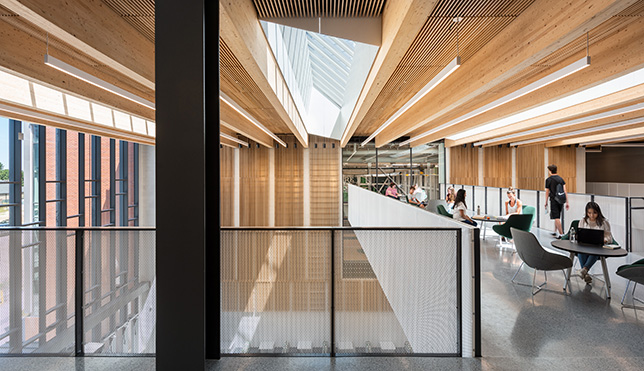
The new Billerica Memorial High School, in the historic town of Billerica (just north of Boston), emphasizes a flexible learning environment and serves as a community resource. Inside, skylights and large windows create an open and bright environment.

The $176 million project was designed by Perkins and Will, constructed by Shawmut Design and Construction and project managed by Leftfield.

The new building is built on the old school site and will include a stadium, turf field, courtyard with an outdoor stage and movie screen, which will be completed by the end of the school year. Inside, skylights and large windows create an open and bright environment.  

Billerica Memorial, designed with community in mind, can accommodate town-wide events in the gym, auditorium and dining commons. Additional site improvements like bike and walking paths and a quad-style civic green will offer lots of spaces for the community to gather.

Perkins and Will incorporated the high school’s past and the town’s history as a New England mill town into their design. They integrated archival photos of the high school, including some of former U.S. President John F. Kennedy visiting the school as a senator, into the interior design. They opted for traditional building materials while also adding a modern touch.

“At every scale, we used simple, honest materials — wood, brick, steel — in thoughtful, inventive compositions. In that way, we marry the architectural grammar with the community’s story,” Patrick Cunningham, designer at Perkins and Will, said in a press release.

About the Author

Yvonne Marquez is senior editor of Spaces4Learning. She can be reached at [email protected].

Featured

  • Rethinking K-12 Schools as a Continuous Learning Experience

    Most students move through three or more separate facilities during their K-12 journey, yet the built environments they encounter at each stage have traditionally been designed in isolation, with little continuity in spatial language, learning philosophy, or physical resources. Each new school is a reset with different layouts, learning models, expectations, and ways of moving through a building. The next generation of school design is making the case that the first day of kindergarten and the last day of high school can and should feel connected through common support systems and infrastructure in the physical environment.

  • Planning with Clarity: Using AI to Make Better Campus Decisions, Not Just Better Designs

    Higher education leaders are being asked to make increasingly high-stakes decisions about campus facilities amid greater uncertainty than ever before. Social and economic pressures, shifting enrollment, and evolving learning models compete with growing deferred maintenance needs to strain even the most robust infrastructure budgets.

  • Virginia Tech Tops Out New College of Engineering Building

    Virginia Tech in Blacksburg, Va., recently celebrated the topping out of Mitchell Hall, which will soon stand as the largest College of Engineering building on campus, according to a news release. The university partnered with Skanska on the 285,500-square-foot facility, which has an expected completion date of winter 2028.

  • Children walking along bright school corridor with motion blur

    How Next-Gen Design Is Reshaping the Student Experience

    The environments where students learn play a crucial role in shaping their growth in and out of the classroom. By centering design on well-being, flexibility, and purpose, districts can ensure their facilities remain vibrant community assets for many years to come.