All-Electric Mobile Preschool Brings Programming to Colorado
- By Yvonne Marquez
- 09/28/20
A Colorado non-profit will launch a mobile preschool experience in October for families with children ages 3 to 5 years old who do not attend a traditional preschool program. Vail Valley Foundation’s YouthPower365, along with Winnebago’s Specialty Vehicle Division, unveiled an all-electric, emission-free vehicle called the “Magic Bus” Mobile Preschool.
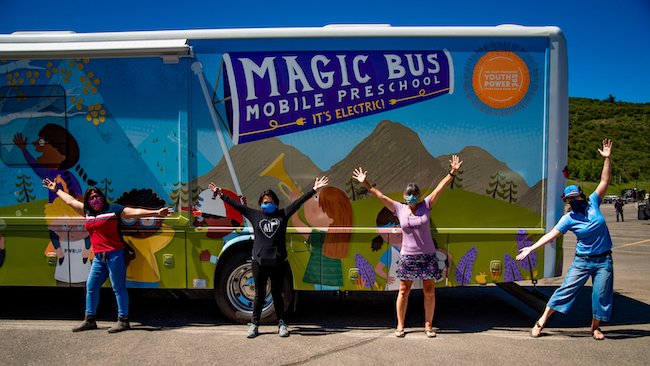
The all-electric bus will join a gas-powered counterpart to serve neighborhoods in Eagle County, Colorado beginning Oct. 5. Classes will be an hour-and-a-half long, four days a week and free of charge to help make early childhood learning available to as many children and families in the community as possible.
“The children and families served by the Magic Bus need to be kindergarten-ready even considering the current crisis,” YouthPower365 PwrUp Senior Manager Kendra Cowles said in a press release. “The Magic Bus plays a critical role in preparing them to successfully transition to school.”
Children will be able to take part in songs, read-alouds, exercise games and vocabulary-building activities in English and Spanish to help prepare fore kindergarten.
“The bus is customized to operate as a center-based preschool classroom, complete with dramatic play and kitchen areas, building blocks and plenty of dinosaurs,” Cowles says.
The Magic Bus is comprised of Winnebago Industries’ standard J33SE zero-emission commercial vehicle and utilizes Motiv Power Systems’ all-electric EPIC Ford F-53 chassis. Summit Bodyworks worked on the vehicle upfit.
“We are pleased to see our all-electric vehicle platform being used to provide early childcare programs for Eagle County’s low-income families. The all-electric vehicle will enable operation in a quiet, emission-free manner,” Robert Kim, Director of the Winnebago Industries Specialty Vehicle Division, said in a press release.
COVID-19 protocols such as social distancing, face masks, frequent hand washing and cleaning will take place on the bus.
About the Author
Yvonne Marquez is senior editor of Spaces4Learning. She can be reached at [email protected].