Grand Canyon U Students Help Build COVID-safe Outdoor Theatre
- By Dian Schaffhauser
- 10/07/20
Faculty, staff and students at Grand Canyon University's College of Fine Arts and Production have constructed an outdoor theatre for use this play season, which addresses COVID-19 restrictions while still allowing students (and their audiences) to enjoy live productions. During the first production, The Comedy of Errors, students wore clear face masks.
The project, which took about a month, called on student workers and cast members to pitch in on construction of the stage, which is located on the lawn in front of the college's building.
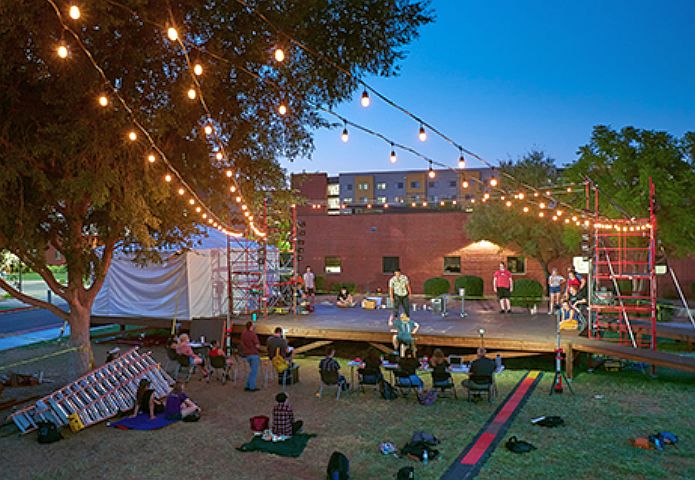
The 40-foot stage is surrounded by designated seating areas for audience members, allowing families to sit together while also remaining distanced from others. The lighting resembles an outdoor café. The set also has a booth for controlling stage lighting and sound. All plays will be livestreamed for people who prefer to watch from home. The first production is already available for viewing on GCU's YouTube channel.
"It's much different than one of our standard builds for a theatrical show because we don't normally have to build an entire theatre," said Technical Director Brad Cozby in a college article.
Cozby said he worked with the college's Dean, Claude Pensis, and Assistant Dean, William Symington, on the effort. "There were a lot of talks among the three of us on how we could make something like this happen," Cozby said. "I was given a list of objectives for what the stage needed to accommodate, and then I took that and worked through the engineering of it all."
"I think that artists and particularly performing arts folks are used to being adaptable," Symington added. "Creative problem-solving is literally what we do every day. When we're working on a project, it's never sort of a set situation where we're like, 'Oh we'll just do it the same way as we've always done it.' It never works that way."
Cozby said his favorite part of the initiative was working alongside students. "They've really thrown themselves into this project whole-heartedly," he noted. "It's just been an absolute joy to work with them and make all of this happen."
About the Author
Dian Schaffhauser is a former senior contributing editor for 1105 Media's education publications THE Journal, Campus Technology and Spaces4Learning.