UArizona Constructing Flexible Research Spaces for Interdisciplinary Projects

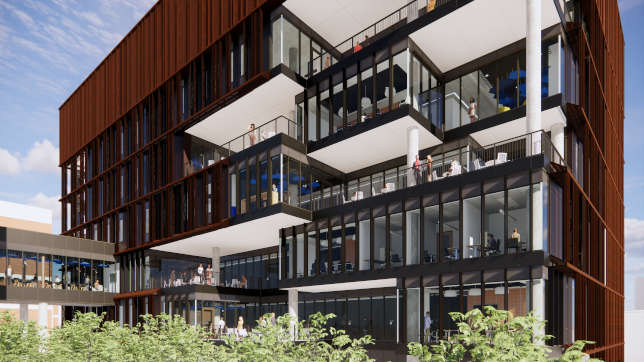
University of Arizona broke ground this week on its new Grand Challenges Research Building, a 115,000-square-foot facility that will house a variety of labs, offices and flexible research spaces.

"Grand Challenges" refers to the second pillar of UArizona's five-pillared "living" strategic plan. The Grand Challenges pillar involves "tackling society’s biggest challenges by enabling discoveries that will fundamentally shape the future."

To that end, the new seven-story building will will serve a wide range of functions. According to UArizona, the ground floor will include "public spaces, study spaces and meeting rooms to support student engagement and instruction."

The three floors above that will include "laboratories and offices dedicated to faculty growth in the James C. Wyant College of Optical Sciences."

The remaining three floors will be "dedicated to research laboratories and offices for centers and cross-campus interdisciplinary programs, including the new Center for Quantum Networks, led by the College of Optical Sciences."
UArizona Constructing Flexible Research Spaces for Interdisciplinary Projects
Source: University of Arizona/ZGF Architects and BWS Architects.

The cost of the building was reported at $99 million. It will be connected to the Meinel Optical Sciences Building. Construction is expected to be completed by February 2024. Design is being handled by ZGF Architects and BWS Architects. Construction for the project is being handled by Kitchell Contractors, which was also "the contractor for the university's Health Science Innovation Building, a 220,000-square-foot building that opened in 2019," according to UArizona.

About the Author

David Nagel is the former editorial director of 1105 Media's Education Group and editor-in-chief of THE Journal, STEAM Universe, and Spaces4Learning. A 30-year publishing veteran, Nagel has led or contributed to dozens of technology, art, marketing, media, and business publications.

He can be reached at [email protected]. You can also connect with him on LinkedIn at https://www.linkedin.com/in/davidrnagel/ .


Featured

  • Benson Polytechnic High School in Portland, OR

    Preserving Legacy, Designing for the Future

    As historic academic buildings age, institutions face a difficult decision: preserve and adapt or demolish and rebuild. How do we honor the legacy of these spaces while adapting them to meet the needs of modern learners?

  • UNL Kiewit Hall

    Designing for Engineering Excellence: Integrating Sustainability and Wellness at UNLs Kiewit Hall

    Kiewit Hall at the University of Nebraska-Lincoln exemplifies how academic institutions can integrate sustainability and wellness into modern learning environments. With an integrated and collaborative team approach, Kiewit Hall addresses enhanced learning and creativity, physical health, and mental wellness, and fosters a sense of community through innovative design, operations, and policy solutions.

  • Different Starting Points, Same End Goal

    Higher education campuses can enhance student experience by implementing mobile credentials to streamline building access, on-campus payments, and access to other amenities. This enables students to connect to their campuses through the technology they use most: their mobile devices.

  • Illinois State University Breaks Ground on College of Fine Arts Transformation

    Illinois State University in Normal, Ill., recently held a groundbreaking ceremony for the Wonsook Kim College of Fine Arts transformation project, according to university news. The series of new constructions and renovations will upgrade spaces in Centennial East, the Center for the Visual Arts, and the Center for the Performing Arts, as well as replace the existing Centennial West facility with a new Commons Building.

Digital Edition