New Table Design Serves as Multi-Student Workstation with Storage
- By Dian Schaffhauser
- 11/15/21
A Michigan furniture company has introduced a new kind of table for classrooms. The MiEN Company's KIO Tinker table is a 360-degree mobile bookcase that serves as a workstation for up to four students. The table provides storage and workspace and is intended for use in classrooms, media centers, makerspaces and STEM/STEAM spaces.
The middle of the tabletop opens to an inner compartment where objects can be stored. But the lid, when put in place, is also flush with the rest of the table's surface, to offer a smooth 48-square-inch work surface. Teachers can also remove the top lid and use the open top space as a holder for plastic storage bins (up to nine inches deep), placing work materials within easy reach of students.
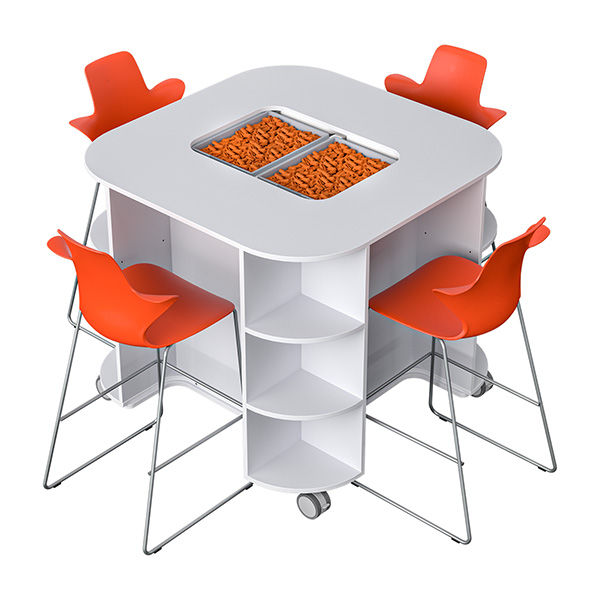
The table includes three tiers of adjustable shelves on its four sides along with three-tier fixed shelving on all its corners. The compartment lids and removable shelving can be stored inside an inner compartment.
Students sit at the table on stools or café-height chairs.
"KIO Tinker's large surface area and various storage possibilities make it the ideal table for exploring, creating and investigating," said Dr. Christina Counts, the company's vice president of education, in a press release. "The built-in flexibility of its patent-pending design takes it from a bookcase to a four-person workstation to a storage unit in seconds. Students can use it whether they're standing or seated. Casters can be added for easy mobility. In short, this durable, future-ready unit adapts to your needs in any learning environment."
About the Author
Dian Schaffhauser is a former senior contributing editor for 1105 Media's education publications THE Journal, Campus Technology and Spaces4Learning.