New Alabama STEM Complex Reaches Construction Milestone

The new Science and Engineering Complex at the University of Alabama at Birmingham (UAB) recently celebrated a construction milestone. Hoar Construction announced the topping out of Phase I of the new facility, which means the building has reached its highest point. Construction is scheduled for completion by spring 2023, according to a news release.

The new complex costs an estimated $76 million and will cover 138,842 square feet on campus. The facility is the first of a three-step project whose goal is to unite all basic science studies, both undergraduate and graduate, in one complex. The four-story structure will house labs and classrooms for biology, chemistry and physics; faculty and staff offices; and specialized areas like an optics lab and cold growth environment rooms.
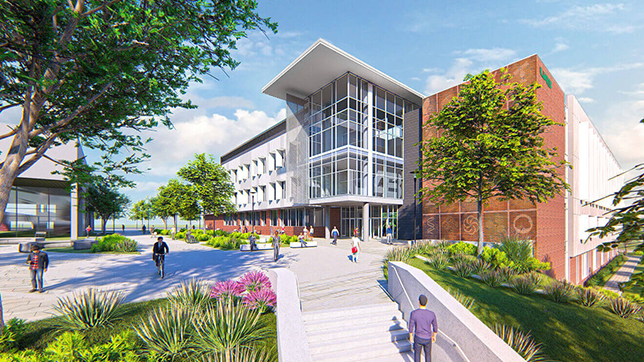
University of Alabama Birmingham Science Engineering Complex

“We are proud to continue our relationship with UAB through the construction of its new Science and Engineering Complex, which will play an integral role in unifying students and faculty while establishing the university as one of the region’s premier science research institutions,” said Chris Ryals, Superintendent for the project. “Hoar is dedicated to expanding its reach into all sectors of higher education, and we are pleased to play a part in the university’s next chapter of growth in our home base of Birmingham. We look forward to completion next year as we partner with UAB on turning this longstanding vision into reality.”

Construction began in February 2021. The university also partnered with lead architect Goodwyn, Mills & Cawood for the project’s design.

About the Author

Matt Jones is senior editor of Spaces4Learning. He can be reached at [email protected].

Featured

  • Rethinking K-12 Schools as a Continuous Learning Experience

    Most students move through three or more separate facilities during their K-12 journey, yet the built environments they encounter at each stage have traditionally been designed in isolation, with little continuity in spatial language, learning philosophy, or physical resources. Each new school is a reset with different layouts, learning models, expectations, and ways of moving through a building. The next generation of school design is making the case that the first day of kindergarten and the last day of high school can and should feel connected through common support systems and infrastructure in the physical environment.

  • St. Lucie County, Fla., Breaks Ground on New K–8 School

    St. Lucie Public Schools in St. Lucie County, Fla., recently held a groundbreaking ceremony for a new K–8 school, according to a news release. The district partnered with Spiezle Architectural Group, Inc., for the design of the upcoming Ft. Pierce K–8 School, which comprises six buildings covering 215,000 square feet.

  • school building with glowing circuit board patterns

    AI Is Coming to Schools — But Most School Buildings Still Run on Institutional Memory

    As school districts race to introduce AI into classrooms, administration, and curriculum planning, another conversation is happening behind the scenes: How prepared are school facilities themselves for the operational demands AI will create?

  • Fellowes Expands Finish and Wall-Covering Options for Architectural Wall Systems

    Fellowes Architectural Solutions has expanded the materials library for its architectural wall systems with a series of new finishes and wall-covering options intended to provide architects and designers with additional choices for commercial interiors, according to a company news release.