Riverside Community College District Completes $29.3M Renovation Project

Riverside City College recently announced the completion of a $29.3-million renovation project, according to a news release. The college partnered with Nineteen Six Architects and builder C.W. Driver Companies to convert a 1960s-era academic building into a new Business, Law, and Computer Information Systems Building. The project created 34,055 square feet of new learning space and took about 18 months to complete.
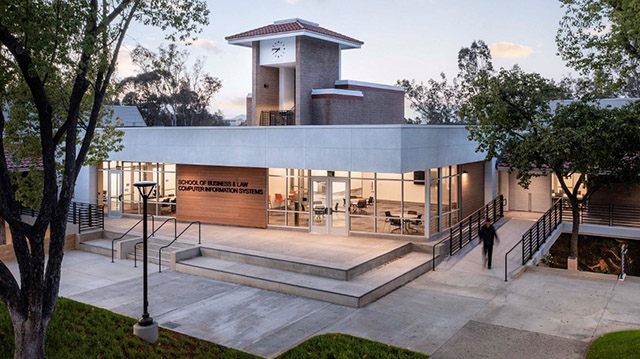

Ohoto courtesy of C.W. Driver Companies

Work involved demolishing all interior spaces to create new classrooms, conference rooms, testing centers, computer labs, and a multipurpose room, the news release reports. The site formerly consisted of a two-story classroom building and four-story service tower. The retrofit united the two structures via an addition on the upper level that also made space for a lobby and main entry, circulation spaces, meeting rooms, and open study spaces.

“This is our second project with the Riverside Community College District in the last couple of years. Previously we worked on the Ben Clark Public Safety Training Center at Moreno Valley College,” said Dave Amundson, C.W. Driver Companies Project Executive. “It’s another example of a repeat client that we work to grow a long-term relationship with us through new projects.”

The addition’s lower level features storefronts that provide additional interior access between the two buildings. Further new amenities include courtroom lecture space, a Cyber Security Lab, a Network Operation Center, and space for computer servers. The project was also designed according to LEED Gold Certification, the news release reports.

About the Author

Matt Jones is senior editor of Spaces4Learning. He can be reached at [email protected].

Featured

  • Rethinking K-12 Schools as a Continuous Learning Experience

    Most students move through three or more separate facilities during their K-12 journey, yet the built environments they encounter at each stage have traditionally been designed in isolation, with little continuity in spatial language, learning philosophy, or physical resources. Each new school is a reset with different layouts, learning models, expectations, and ways of moving through a building. The next generation of school design is making the case that the first day of kindergarten and the last day of high school can and should feel connected through common support systems and infrastructure in the physical environment.

  • Planning with Clarity: Using AI to Make Better Campus Decisions, Not Just Better Designs

    Higher education leaders are being asked to make increasingly high-stakes decisions about campus facilities amid greater uncertainty than ever before. Social and economic pressures, shifting enrollment, and evolving learning models compete with growing deferred maintenance needs to strain even the most robust infrastructure budgets.

  • Virginia Tech Tops Out New College of Engineering Building

    Virginia Tech in Blacksburg, Va., recently celebrated the topping out of Mitchell Hall, which will soon stand as the largest College of Engineering building on campus, according to a news release. The university partnered with Skanska on the 285,500-square-foot facility, which has an expected completion date of winter 2028.

  • Children walking along bright school corridor with motion blur

    How Next-Gen Design Is Reshaping the Student Experience

    The environments where students learn play a crucial role in shaping their growth in and out of the classroom. By centering design on well-being, flexibility, and purpose, districts can ensure their facilities remain vibrant community assets for many years to come.