Turning Crisis into Opportunity: Transforming New City School
- By Matt Costantinou
- 01/13/26
When New City School in St. Louis suffered catastrophic flood damage in July 2022, the event could have marked a serious setback for the 100-year-old institution. Instead, the school and its project partners transformed a crisis into a forward-looking opportunity, reimagining the lower level as a cutting-edge, student-centered early childhood education environment that reflects both innovation and resilience.
A Historic Foundation
Located in the city's Central West End neighborhood, New City School occupies a building with a storied past. Originally constructed in 1901, the facility had previously served as Mary Institute and later Lutheran High School before becoming home to New City School in the 1970s. Over the years, the structure has withstood the wear and tear of time. In July 2022, however, an unprecedented rainstorm overwhelmed city storm drains and left the school's garden-level classrooms and common areas submerged under floodwater.
The flooding severely damaged not only four early childhood classrooms but also essential infrastructure including HVAC, electrical, and plumbing systems. Indoor air quality became a concern, and large portions of mechanical and architectural systems needed complete replacement. But instead of simply restoring the space, New City School partnered with design firm Christner Architects and McClure Engineering to rethink the entire environment, both functionally and aesthetically.
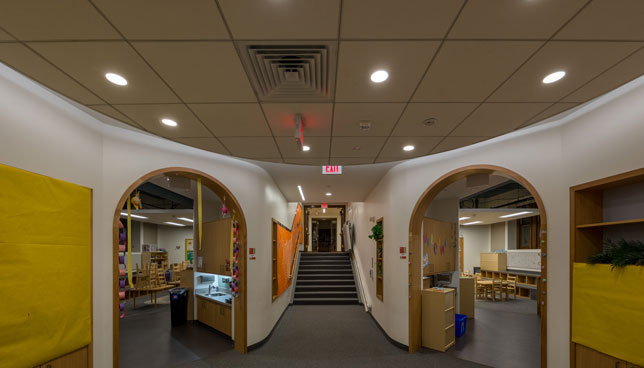 New City School (photo courtesy of McClure Engineering)
Forward-Thinking Engineering
The building's age presented immediate challenges. It's a 1930s-era building that hadn't seen major upgrades in decades. In older buildings like this, you're always constrained by low ceiling heights and outdated systems. There are also surprises such as undocumented pipes in the walls, legacy infrastructure, and structural elements that weren't designed to support modern MEP loads.
Because the flooded area served the school's youngest students, ranging in age from three to six years old, the pressure was on to create a space that was not only safe and functional, but also engaging and comfortable. The school took the opportunity to expand and enhance the classrooms, common spaces, and utility systems with an eye toward long-term performance and adaptability.
MEP Upgrades
One of the most significant infrastructure changes involved the HVAC system. The previous setup, a single air handling unit installed in 1987, had long outlived its useful life. That unit, along with its outdated ductwork, was demolished and replaced with a new 32-ton air handler. The new system includes a mixing box, outdoor and return air dampers, DX cooling coil, heating coil, and a direct-drive plenum fan array equipped with variable speed control and economizer settings.
This upgrade gives students a more comfortable environment, which is crucial for early learning. It's not just about temperature. Proper humidity control and ventilation make a real difference in how kids feel and focus throughout the day.
The plumbing overhaul was equally intensive. Serving the new restrooms and classroom sinks required extensive trenching and overhead piping. This behind-the-walls work ensured that the system could meet current codes while also simplifying future upgrades.
Fire protection received a full modernization as well, with new sprinkler heads and a high-tech fire alarm system featuring addressable pull stations, smoke and heat detectors.
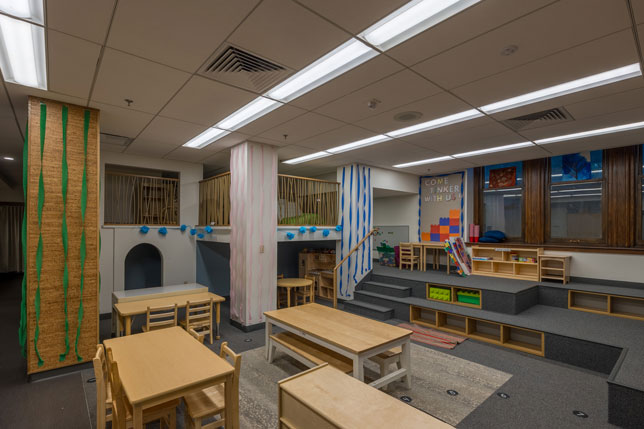 New City School (photo courtesy of McClure Engineering)
Lighting Design
One of the standout achievements of the renovation lies in its lighting design. The engineering team replaced outdated fixtures with energy-efficient LED systems, but more importantly, they created a flexible, engaging lighting environment that enhances the learning experience.
Lighting is no longer just on or off. Each classroom has different zones and teachers can control lighting in each zone independently. That supports a range of activities, moods, and educational needs.
Design elements include indirect cove lighting, randomized down lighting in the central commons area, and whimsical fixtures integrated into ceiling panels designed to resemble flowers. Themed zones, such as a cave or treehouse, are enhanced with custom lighting that supports the imaginative environment.
Energy efficiency is also a priority. Automated systems reduce lighting in corridors by 50% after hours and shut off fixtures entirely after 20 minutes of inactivity. Student artwork in common spaces is illuminated with wall-washing fixtures that adjust brightness based on time of day and occupancy.
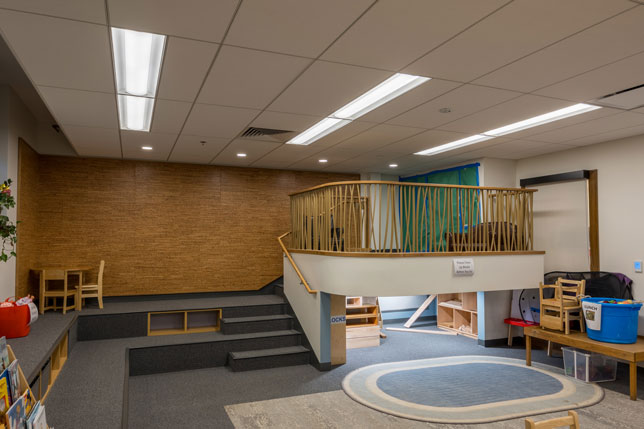 New City School (photo courtesy of McClure Engineering)
Engineering for the Future
Beyond solving the immediate problems caused by flooding, the renovation also sets the stage for smarter infrastructure growth. It wasn't just about fixing what was broken. The team tried to think ahead: "How can we make the next phase of upgrades easier and less disruptive?"
To that end, the engineering team worked closely with Christner Architects to coordinate ceiling zones, utility corridors, and access points in a way that allows for scalability. The new systems are designed to integrate with future mechanical or electrical expansions with minimal rework.
The renovated space officially reopened in early 2024, marking the end of an intense and collaborative rebuilding effort. But what emerged is far more than a restored basement level. It's a reimagined learning environment that blends technical precision with creative intent, a space where systems work seamlessly behind the scenes to support student comfort, safety, and curiosity.
This was a project that turned an unfortunate event into something inspiring. Through the mechanical, electrical, and lighting systems, the team was able to contribute to an environment that helps kids feel more comfortable and engaged. And for young learners, that kind of atmosphere makes all the difference.
The New City School renovation exemplifies how responsive design, smart engineering, and interdisciplinary collaboration can transform adversity into advancement. By turning damage into design opportunity, the school not only preserved its legacy but also future-proofed its infrastructure for generations to come. In doing so, it reaffirms the principle that every challenge is also a chance to create something better.