Niles West High School Natatorium Renovation
School dives into benefits with upgraded lighting
Natatoriums are highly specialized spaces, and luminaires in this setting face several unique challenges. Perhaps the most significant is corrosion, which is exacerbated by high indoor humidity, condensation, and pool chemicals, often resulting in material degradation in luminaires not certified to perform in corrosive environments. Fixtures for this application must, at a minimum, be rated for damp locations and offer the highest protection against moisture and chemical vapors resulting from water treatment.
Additionally, because natatorium fixtures are typically difficult to access, maintenance must be kept to a minimum. If glass were to fall into the pool during maintenance, the entire pool would need to be drained—an expensive and time-consuming effort. Life safety and accident prevention are critical considerations when lighting a natatorium.
Natatorium lighting design should minimize glare and shadows cast onto, and beneath, the water’s surface. When light reaches the water surface at an angle lower than 50 degrees, it creates reflection and glare, which may obscure the lifeguards’ view of swimmers. Light fixtures suspended from the ceiling and shining directly on the pool surface frequently cast dark shadows from the pool edge, which, in turn, darken the walls of the pool shell. Improperly placed overhead lights can also cast distracting shadows from obstructed ductwork, structural beams, and other objects. Indirect illumination is recommended to reduce glare and veiling reflections, improving the clarity of underwater viewing and related safety.
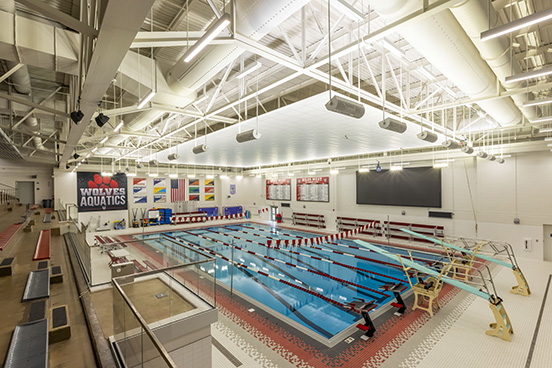 The use of indirect illumination above the pool’s perimeter reflects off the drop ceiling to reduce glare and veiling reflections, and improve the clarity of underwater viewing and related safety.
Photo courtesy of Kenall Manufacturing
Building and operating an aquatics facility is not easy or inexpensive, but improvements in equipment and innovative technologies continue to offer more sustainable and longer-lasting solutions. When considering an aquatics project, keep in mind both the upfront cost, but also the potential savings gained from optimized lighting design, such as corrosion resistant, indirect, IP-rated LED luminaires.
The following table refers to the Illuminating Engineering Society of North America’s RP-06-01 for Sports Recreational Area Lighting.
Illuminating Engineering Society of North America’s RP-06-01 for Sports Recreational Area Lighting
| Class |
Occasion |
Water Surface(lux) |
Deck(lux) |
Water Surface Uniformity
Max:Min ratios
|
Deck Uniformity
Max:Min ratios
|
| Class I |
Professional |
807 |
538 |
1.7:1 |
2.5:1 |
| Class II |
Collegiate |
538 |
215 |
2.5:1 |
4:1 |
| Class III |
Intermediate |
323 |
108 |
3:1 |
4:1 |
| Class IV |
Recreational |
323 |
108 |
4:1 |
4:1 |
Niles West High School Natatorium
In Skokie, Illinois, Niles West High School’s pool and coaches’ offices were constructed in 1960. Since then, the facilities have served thousands of students, athletes, and numerous coaches, and hosted many meets. However, new code requirements and accessibility regulations, along with an aging infrastructure, propelled major upgrades. The pool is part of a five-year facility improvement project. Renovations include upgrades to the structure and design of the natatorium, as well as the replacement of the pool deck, tiles, and the concrete beneath the pool. New features include the ceiling, additional storage areas, starting blocks, and an entrance to the pool deck that complies with accessibility guidelines.
Additional renovations include changing the gutter system, which added nine inches of water; completely overhauling the pool’s mechanical and HVAC systems; updating timing equipment; remodeling coaches’ offices; adding an enhanced grandstand area including glass railings for unobstructed sightlines and new school graphics; and updated record boards to celebrate achievements and create a vibrant atmosphere; and new lighting. The $7.3-million pool renovations were covered by funds allocated through the school district’s budget.
Stuckey Construction, a pool constructor certified by the Illinois Department of Public Health, began renovations in February 2024 and completed the project by August 2024, in time for the start of the new school year.
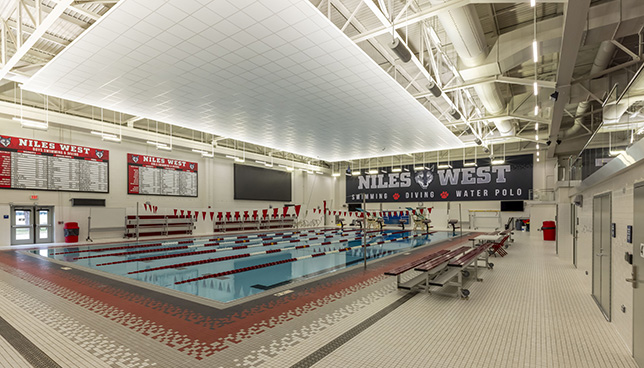 As part of the school’s $7.3 million pool renovation, the LED luminaires are IP65 rated, offering the highest safeguard against moisture and water treatment chemical vapors, ensuring their longevity.
Photo courtesy of Kenall Manufacturing
Lighting System
The 28,430-square-foot complex previously included a metal halide (MH) lighting system installed over the pool. To access the lights for maintenance, the facilities team had to climb onto a non-compliant catwalk above the dropped ceiling, posing safety concerns. MH lamps degrade over time, losing light output and color consistency, and typically have a lifespan of 6,000 to 15,000 hours before the bulbs require replacement.
Marcus Holleran, facilities manager at Niles West High School, knew a new lighting system was critical to the renovation:
- Dim lights made it difficult for spectators to see the swimmers at meets
- Low light levels were a safety issue for lifeguards
- There were concerns for the potential of glass to break and drop into the pool during maintenance, which would require draining 190,000 gal of water
- MH technology requires 10-15 minutes of “cool down to relight,” meaning the bulbs needed to cool down enough before they could be re-lit again, which was very inconvenient
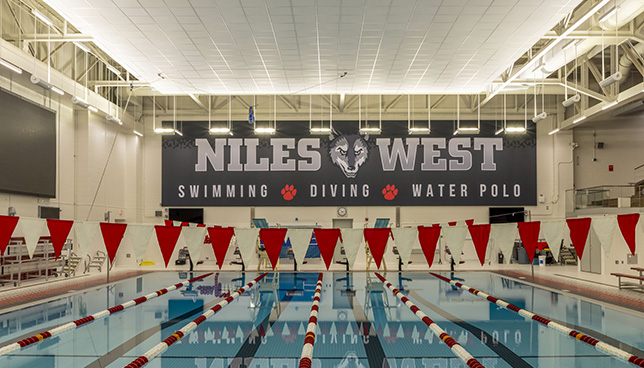 The new LED pendant luminaires on the perimeter of the pool are a dramatic improvement over the previous metal halide fixtures – they strike instantly, provide far more lumens, will last for years, and are cost effective.
Photo courtesy of Kenall Manufacturing
Studio GC, the architectural and design firm retained by the school district for the project, specified indirect lighting above the pool’s perimeter to reflect off the dropped ceiling. This design evenly distributes the lighting over the pool. The architectural firm worked with 20/10 Engineering Group to address photometric considerations. Based on these studies, the project required 32 LED luminaires engineered to perform in high-humidity, caustic, and corrosive environments, as well as hard-to-service areas, featuring IP65-certified housings. The International Electrotechnical Commission has developed the ingress protection (IP) rating system, which grades the resistance of an enclosure against the intrusion of dust or liquids. Each IP water rating consists of two numbers:
- First digit (solid protection) is rated on a scale from 0 (no protection) to 6 (no ingress of dust).
- Second digit (water protection) rates the enclosure’s protection against liquids and uses a scale from 0 (no protection) to 9 (close range, high-pressure, high temperature water jets from different angles).
“The new lights are terrific,” said Holleran. “They strike instantly, provide more lumens than our old MH lights, will last for years, and are cost-effective. In addition to the dramatically longer life of LEDs compared to MH—100,000 [hours] versus 6,000–15,000 [hours]—the facilities team no longer has to precariously balance on a catwalk to change bulbs.”
The school’s swim team members also welcome the lighting upgrade.
“I appreciate how bright the pool facility is now due to the new lighting. It makes the space shine, feel warmer and more comfortable,” said Dr. Dana Krilich, Niles West High School athletic director.