Working From the Outside In
Thinking Outside the Box
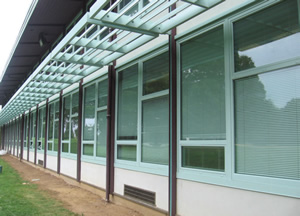
Photos courtesy of Klein & Hoffman
When the Welsh Valley Middle School in Lower Merion, Pa., replaced part of its building envelope in 2009, its windows, it wasn’t just a matter of old ones out, new ones in. Instead, the school, which dates from 1957, underwent a replacement project that paid close attention to performance and long-term maintenance.
The range of work signals a wider move in varying districts to address building envelope issues strategically and in combination. The goal is essentially leaving no stone, or brick, unturned in the gathering effort to make buildings as sustainable and efficient as possible. Looking at it in terms of building envelopes, that effort starts from the outside in.
At Welsh Valley, for instance, a “full-scale window replacement” aimed to help boost thermal performance and reduce maintenance requirements, according to the engineering firm that did the work, Klein and Hoffman, with Garozzo & Scimeca Construction, and Architectural Testing Inc. As part of that undertaking, the firm conducted air and water infiltration tests to assess window performance, just part of an exacting process.
Elsewhere, Craig Schwitter and Erik Verboon, of Buro Happold argue that “the relationship between a mechanical system and the building envelope cannot be ignored anymore.” Constraints, especially budgetary ones, on educational facilities mean that they must be very efficient, and how a façade, to take one component, performs is a key way to get there.
Among other things, building envelope components, including the façade, “make a major contribution to the sustainability of a building, influencing both energy efficiency and the quality of the internal climate,” according to Buro Happold. In other words, there are multiple ways of looking at a façade, including its role in terms of energy, lighting and daylighting, as Schwitter and Verboon explain. Accordingly, the role of façades is generally being seen as more important than typically was the case years ago.
The move toward more energy-efficient buildings, not just for schools but across the board, is bringing with it new standards and expectations. New York City’s Local Law 84 may be a sign of things to come, point out Schwitter and Verboon.
The law, part of that city’s “Green, Greater Buildings Plan,” “is designed to ensure that information about energy is provided... and that the most cost-effective energy efficiency measures are pursued,” according to the city.
It stands to reason. After all, a significant amount of a building’s carbon footprint is associated with the energy it takes to run it — lighting, heating and cooling. Various elements of the building envelope can make a difference. Thus, Schwitter notes an increasing awareness that in order to make an impact in this area, “we have to deal with buildings” and “not just as bricks, but more broadly, how does the building perform?”
Small or large, urban or rural, school buildings need to perform. Old or new, too: districts across the country have buildings that have grand façades, as well as interior features, that predate various mechanical and ventilation systems. Yet in a sort of what’s-old-is-new-again twist, such buildings may have advantages that should be taken on their own merits, in addition to their massing and location. As Schwitter points out, many of those buildings, without air conditioning for example, have features including operable windows that can be included as part of renovations intended to improve natural ventilation and daylighting.
There can be many factors to consider in such cases, but taking a pragmatic approach along that line — working with what you have, essentially — dovetails with another frequent requirement that districts face when renovating a building’s envelope: sensitivity to aesthetics and history.
Back at Welsh Valley, there was a related dynamic. Care had to be taken to replicate the original steel windows at the five-building school complex, in order to “preserve the integrity of the design” as part of a façade condition assessment and window replacement by Klein and Hoffman.
Another Lower Merion project took a hybrid approach. At the district’s Administration Building, explains Klein and Hoffman’s Alice Sloan, “technicians restored the steel windows on the main façade, and replaced the windows on the other façades with new aluminum windows that approximated the historic appearance.” Such an approach has become more viable in recent years because, according to Sloan, “window technology has greatly improved… replacement windows are now better able to approximate the profiles of the historic, as well as provide better insulation.”
Replicating another historic feature, a roof, was part of a challenging project at Roxboro Elementary School in Cleveland Heights, Ohio. According to Technical Assurance, its work at the school included the installation of “special dimensional asphalt shingles to simulate the original flat red clay tile and modified bitumen roofs.” The firm continues that, “the steep roof’s box gutter was challenging and required a complete reworking of the gutter wood framing and sheathing, and specialized lead-coated copper sheet metal lining.” There was more, Taylor explains: “Additionally, the stone cornice and façade belt courses had to be repaired and repinned to prevent a falling debris hazard as well as complete restoration.”
Building envelopes that work in concert with efficient systems are important components of building performance, and finally, as is another important component. Schwitter and Verboon put it this way: “Behavior impacts building performance.” In other words, every building user is an important part of the effort to boost the sustainability of school buildings — an effort that starts from the outside in, with building envelopes.
Some suggested ways to approach the process of renovating a building envelope:
- Remember that your facility manager is a key member of your team. Work closely with that person to sustain an organized, consistent program for the challenging work of maintenance and repairs to your building envelope.
- Maintain relationships “with manufacturers, specialized contractors and engineers/architects,” says Klein and Hoffman’s Peter Power, because it “generally improves the level of service and overall satisfaction with maintenance efforts.”
- Think about today and tomorrow. Educational institutions, notes Robert Hotes of Klein and Hoffman, “need to plan for sustainable management of their built assets both now and in the future.” Building envelopes are part of that effort.
Scott Berman is a freelance writer with experience in educational topics.
This article originally appeared in the School Planning & Management June 2013 issue of Spaces4Learning.