DePaul University: The Theatre School
For the past 30 years, the Theatre School at DePaul University in Chicago operated out of “temporary” facilities — a well-worn, former elementary school and a reconverted nunnery.
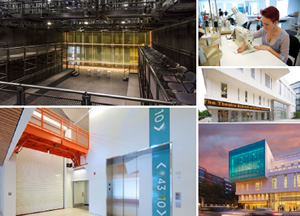
PHOTOS: TOP LEFT, BOTTOM RIGHT © JEFF GOLDBERG / ESTO
PHOTOS: BOTTOM LEFT, TOP AND MIDDLE RIGHT © JEFF CARRION
Since opening in September 2013, the new $72-million, 165,000-square-foot Theatre School at DePaul — designed by Pelli Clarke Pelli and Schuler Shook Theatre Planners in unusually deep collaboration with school faculty and administrators — provides new classroom, rehearsal, design and performance spaces that finally align DePaul’s facilities with the school’s national ranking for theatre training excellence.
The five-story school houses two new theatre spaces: a 250-seat thrust stage theatre and a 100-seat flexible theatre. The groundfloor entrance opens into the “living room” of the building — a glass-enclosed lounge, concessions space, box office and lobby — where patrons and students are visible from the street. Floor-to-ceiling glass also places daily activities in the scene shop, metal shop and paint shops on display for the surrounding neighborhood.
The second through fifth floors intentionally mix spaces devoted to costumes, makeup, props, lighting laboratories, new media workshops and classrooms. All classrooms offer some level of performance and production capabilities. The building also contains three dedicated rehearsal spaces, each sized to replicate the dimensions of DePaul’s three different stages.
Projecting out 45 feet up on the fourth floor, the flexible theatre captures attention from the street below and serves as a bold new sign for the university, particularly when illuminated at night.
By emphasizing transparency, DePaul’s new Theatre School puts the excitement of a college-level theatre education on clear view for the neighborhood, providing a behind-the-scenes glimpse inside one of the top professional collegiate theatre conservatory programs in the U.S. Ultimately, the building is widening artistic horizons, adding vitality to the community and serving as a new recruitment tool welcoming generations of new students, faculty, artists, performers and audiences for years to come.
This article originally appeared in the issue of .