Lighting Controls Save Energy
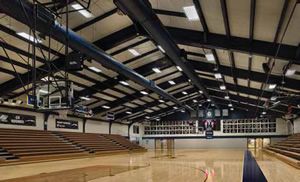
With Lutron High Bay Athlite Fixtures, Moravian College was able cut previous electrical output by 83 percent in their recreational gym.
Moravian is a small, residential college in Bethlehem, PA, founded in 1742 — the sixth oldest college in the United States. It is a school steeped in the liberal arts tradition and deeply committed to its students. To strengthen the sense of campus community, the school had long planned to renovate its Athletic and Recreation Center. Construction involved updating its competition and recreational gyms, and adding a 10,000-squarefoot fitness center for faculty and students.
As part of the overall construction and renovation project, the college identified the need for an energy-efficient lighting retrofit that would allow centralized control and programming of the lighting in all the athletic facilities, and would also deliver significant lighting energy savings. Work had to be done quickly, during the summer break, in order to minimize disruption to the students and the athletic program.
In both gyms, Moravian replaced inefficient, high-intensity discharge (HID) lighting with Lutron High Bay Athlite fixtures and digital fluorescent dimming ballasts. The school also installed preset lighting controls, eliminating the guesswork previously used to create the right light level.
The energy savings — reported via Lutron GreenGlance energy reporting software — were staggering. Compared to the original HID lighting, the new system has already saved 83 percent of the electric output in the recreational gym and 71 percent in the competition gym.
“Our students appreciate the fact that the court is more evenly lit, and that the new lights are silent. The loud buzz from the old lights is completely gone. That means it’s better for the athletes,” notes Mary Beth Spirk, the head coach of the Women’s Basketball Team at Moravian.
www.lutron.com
This article originally appeared in the issue of .