Marlboro College
Victory Garden and Community Greenhouse
PHOTOS COURTESY OF MARLBORO COLLEGE
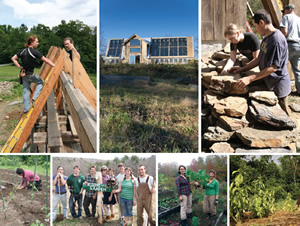
The victory garden and Community Greenhouse at Vermont’s Marlboro College were born of student initiative. The projects — idiosyncratic of the self-governing community and student-led academic program — were created bottom-up. The garden and greenhouse are spaces of experimentation to relearn essential human skills — i.e. how to grow food. The students built knowledge by building community, while decreasing dependency on industrial agriculture.
The projects are in a state of continual evolution. Every year a new Farm Committee takes over the space and learns how to use the site while managing the new group and developing new projects. The farm hosts both community and academic projects. Over the years, students have grown hops to use in local craft beer, built a bread oven, installed a fire ring and, most dramatically, created a permanent, 700-square-foot, solar-heated greenhouse.
Curricular benefits are also reaped from outdoor learning at the site. Professor Todd Smith’s chemistry classes grow sunflowers at the farm. Seeds are then harvested and pressed for oil, which is then used in experiments to generate biofuels. Biology professor Jennifer Ramstetter teaches an agroecology course at the farm in which students are planting native edible plants: blueberries and nut trees, for starters. Writing professor Kyhl Lyndgaard even used the compost pile for a site-specific, group reading place to examine Maxine Kumin’s poem “The Brown Mountain.”
The space lives on and adapts to the current needs and interests of the community. Students are developing a longterm plan for sustainable growing. A new student-faculty-staff collaborative class is building microcomputers to measure the greenhouse’s efficiency for a datadriven design to create the most efficient interior growing space. New challenges create new opportunities for knowledge experimentation.
This article originally appeared in the issue of .