Four Things You Need To Know About Emergency Lighting
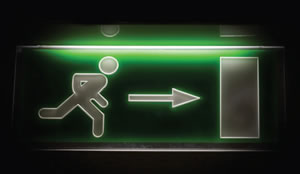
PHOTO © ISTOCKPHOTO/CSAKISTI
Emergency lights and exit signs are some of the most integral, yet overlooked, elements of a building’s life safety program. When the Occupational Safety and Health Association (OSHA) imposes fines for non-compliant emergency lighting, it can cost up to $7,000 for a first-time violation and as much as $70,000 for a repeat violation. Cintas Corporation, a provider of fire protection and life safety services, has identified four key considerations every facility manager should take to keep their emergency lighting systems compliant with National Fire Protection Association (NFPA) and OSHA regulations.
“Much like a fire extinguisher, emergency lights often do not get much attention until they are needed,” says Jamie Samide, senior director of Marketing for Cintas. “Neglect of your facility’s emergency lighting puts you at serious risk of fines, injuries to students and staff, and resulting legal action.”
Four recommendations to ensure safe evacuation in an emergency include:
- Make sure that all exit paths are adequately lit — There are three areas that should be lighted well enough during a power outage that occupants with normal vision can see. This includes exit access (leading up to the exit), the exit itself, and the exit discharge (outside of the exit). Emergency lights should turn on automatically within 10 seconds of a power outage and last for at least 1.5 hours. Exit routes must also remain visible during any construction or building repairs. In addition to the path of egress, it is important to have emergency lights in enclosed areas, such as stairwells, corridors and lobbies, to ensure occupants can find a safe path of egress.
- Post signage around the facility — Post signs indicating the direction of the nearest exit, if it is not obvious. If there are doorways or passages along the exit route that might be mistaken for an exit, post a sign indicating their actual use. NFPA 101 Emergency Illumination Standards require the exit be clearly marked by a sign with the word “exit” that is not decorated or obstructed from sight. Just like emergency lights, exit signs must be illuminated by a reliable light source that will stay lit in the event of a power outage.
- Ensure regular inspections — The proper maintenance of emergency lights and exit signs greatly reduces the risk of liability for fines, injuries and lawsuits. A quick visual check for physical damage to the exterior of the emergency lighting units and a battery test is required to be conducted on a monthly basis. Regulations mandate a more thorough annual inspection. This includes checking the tightness and cleanliness of battery terminals, measuring the “float voltage” (the constant voltage that is applied continuously to a battery cell) and performing a battery-load test that simulates the unit being lit on battery backup for 90 minutes. Bulbs and batteries should also be replaced as needed.
- Document, document, document! — It is important to keep clear documentation of all monthly and annual inspections and maintain a file where records can be easily located. This documentation will serve as proof that the required work was performed should an incident occur, reducing liability. A certified fire technician should provide documentation noting the unit tested, date of service, type of service performed and his or her name to certify the completion of the job.
“It is important that you keep your people and educational facility protected with an inspection program from a reputable service provider,” says Samide.
This article originally appeared in the issue of .
About the Author
Michael Dorn serves as the executive director for Safe Havens International, Inc., an IRS-approved, nonprofit safety center. He has authored and co-authored more than 20 books on campus safety. He can be reached through the Safe Havens website at www.safehavensinternational.org.