Bicycle-Friendly Universities
- By Amelia Neptune
- 12/01/14
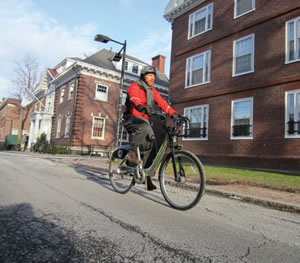
PHOTO COURTESY OF THE LEAGUE OF AMERICAN BICYCLISTS
The numbers are clear: young adults are
choosing to ride more and drive less.
That’s where the Bicycle Friendly University (BFU)
program comes in. An initiative of the League of American Bicyclists
(bikeleague.org), the oldest bicyclist advocacy organization
in the country, the BFU program has certified 100 colleges and
universities in 37 states and Washington, DC, as bicycle friendly.
These BFUs include nine of the top 10 colleges and universities
in the U.S., a growing number of community colleges, Ivy League
standouts, land-grant institutions and many more.
The Bicycle Friendly University program recognizes these
institutions of higher education for promoting and providing
more bikeable campuses for students, staff and visitors. The BFU
program provides the roadmap and technical assistance to create
great campuses for riding. Once they are participants, institutions
are recognized on a medal scale, from Bronze to Diamond.
Colleges and university campuses are unique environments for
their high-density, stimulating atmosphere and defined boundaries.
These factors make them ideal environments to incorporate
bikes. Many colleges and universities have built upon these good
conditions and embraced the enthusiasm for more bicycle-friendly
campuses by incorporating bike share programs, bike co-ops, clubs,
bicycling education classes and policies to promote bicycling as a
preferred means of transportation. With the goal to build on this
momentum and inspire more action to build healthy, sustainable
and livable institutions of higher education, the League of American
Bicyclists created the Bicycle Friendly University program.
The Bicycle Friendly University program evaluates applicants’
efforts to promote bicycling in five primary areas: engineering,
encouragement, education, enforcement and evaluation/planning,
known as the Five Es.
Yale University
“Elevating Yale’s Bicycle Friendly University status from
Bronze to Silver was a strategy in our Sustainability Strategic Plan,
and we felt we improved our offerings for bicyclists by — among
other things — bringing a 50-bicycle bike share to our campus,
and increasing bicycle parking capacity,” says Holly Parker, director
of Yale’s Sustainable Transportation Systems. “In New Haven,
we’re extremely fortunate to have a staff in city government dedicated
to improving the city’s roadways and bike parking options
to make biking a safer and friendlier mode of transportation for
university affiliates and local residents alike.”
Montgomery County Community College
Montgomery County Community College (MCCC) in Pottstown,
PA, is a new Bronze-level BFU — and one of the first community
colleges to join the growing ranks of BFUs.
“As an institution that focuses heavily on sustainability and
green initiatives, becoming a Bicycle Friendly University is yet
another step in the right direction,” says Gregg Heimer, MCCC
Bike Advocacy committee chair. “We’re so excited that we have
been awarded this recognition after three years of improvements
and adding additional bike-related services around campus. Having
a campus with a 100 percent commuting population, it was a
challenge to get to this point, but we focused on specific areas of
improvement and are extremely proud to be recognized for our
advocacy. Looking forward, we hope to increase biking awareness
through local partnerships, improve upon our community infrastructure
to urge bike commuting to campus, and become a role
model for similar community colleges across the country.”
How to Join
Any U.S. institution of higher education may apply to the BFU
program, and the next deadline is August 2015. Interested in
learning more? Visit bikeleague.org/university.
This article originally appeared in the issue of .
About the Author
Amelia Neptune is the program manager for the League of American Bicyclists Bicycle Friendly University program.