Keeping an Eye on Parking
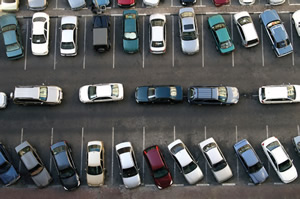
PHOTO COURTESY OF VLADIMIR MARAVIC
If you’re watching a movie and there’s a scene taking place in a parking deck you know something bad is about to happen. Sure, the lighting and soundtrack help set the creepy scene, but there is something about that location. Sprawling and empty, with plenty of dark corners and hidey-holes, parking lots and parking decks intuitively seem scary.
“Parking lots are not dangerous,” insists Jack E. Molenaar, AICP/PP, director of transportation services, Rutgers, The State University of New Jersey in New Brunswick. Molenaar admits that crimes of opportunity — like smash-and-grabs, when a laptop or other valuable electronic device is left in plain sight — still happen. But parking lot crime sprees, where criminals serially break into cars for extended periods, getting more aggressive as time goes on, don’t happen anymore.
And for that he thanks the video surveillance camera. “With the camera, the university police can close those first cases quickly so they never escalate,” he says of the system that was installed between 2006 and 2007. Video surveillance cameras have become commonplace in parking lots and decks around the country and, as a result, schools report a drop in crime. The next generation of technology, license plate recognition, is here and promises to do even more. Are your school’s lots and garages ready for their close-up?
“The three major crimes that happen in parking lots are vandalism, break-ins and auto thefts,” reports Barbara Winkler-Chimbor, director of business development, education, Genetec. She suggests that a university first identifies its hot spots, then look into solutions.
Video Surveillance
The most common solution is the video surveillance camera. Molenaar reports that he oversees 30,000 parking spots at a variety of campus locations, and has between 3,000 and 4,000 cameras pointing at them. As he reported earlier, the cameras deter crime. Convincing some members of the community to accept them was a hard sell at first.
“Older faculty and staff members were leery of ‘Big Brother,’” he says. That concern appears to be generational. “The younger students expected that the cameras were already in place and wanted us to install more.” He says that the students even thought that someone was constantly watching the video feed instead of just reviewing tapes after a reported incident.
The cameras work as a deterrent as well as an aid to solving crimes. Winkler-Chimbor tells of an incident at a university in the downtown of a major West Coast city. The community was plagued by gang activity that was spilling onto the campus. “The school installed a video camera with analytic capabilities at all four entrances,” she says. At first the cameras attracted gang members who initiated new recruits by having them climb their mounting poles and touch the wires, until the analytics notified the police. “An officer was dispatched and word spread quickly through the gang community,” she reports. “Crimes like that dropped off 50 percent.”
License Plate Recognition
License plate recognition technology is a sophisticated take on parking lot safety for schools that want an “automated process,” according to Winkler-Chimbor. She pointed to a case study where Brigham Young University (BYU), in Provo, UT, used Genetec’s product AutoVu to address a variety of issues.
“First and foremost, our AutoVu is a security system. It has solved numerous crimes and has helped prevent crimes,” says Steve Goodman, technology architect and manager of the Communications Center for BYU’s chartered police department. According to the case study, BYU distributes information to the local police when necessary; for example, to show which vehicles were on campus at a specific time to help with accident investigations.
During a recent string of bike thefts, the AutoVu data within the Security Center was used to search for a pattern in vehicles parked near the scene of the crimes. The vehicle belonging to the thief was identified, and the culprit was caught. A situation involving a string of burglaries that were taking place both on and off campus was similarly resolved. The on-campus incidents were tied to a specific vehicle, which was then tagged in the system for monitoring purposes. When that vehicle showed up on campus, the system alerted officers and BYU was able to contact local police to come and apprehend the suspect.
License plate recognition offers other benefits as well. Cars can be registered and managed online, streamlining the process for everyone. “The City of Maryland saved $60,000 a year just by not printing stickers,” said Kevin Clark, global manager of PR and social media, Genetec.
Molenaar agrees that the industry is moving toward license plate recognition, but is not ready to sign Rutgers up for it yet. “I would love to get rid of permits and better serve visitors, but I still think the technology is a bit glitchy.” Winkler-Chimbor acknowledges the issue. “Off-the-shelf cameras just don’t cut it for this technology,” she says. “License plates have a back glare and you need the right type of lens and lighting.” That technology comes at a price.
Joe Paradise, manager of parking and transportation services for the University of Rhode Island, also sees license plate recognition as a goal his school will reach over time. “It would be great to integrate all of our systems under one blanket, but there are budget constraints,” he says. “When it comes to safety there shouldn’t be.”
This article originally appeared in the issue of .