Shifting Landscapes
- By Stephan Howick
- 03/01/15
Enter into a conversation regarding new trends in educational facilities, and it may be a while until you reach the topic of playgrounds and outdoor learning spaces. Yet these two areas are evolving in much the same manner as the interiors of our Next Generation schools. Driven by increasing expectations for amenities, a renewed focus on the environment and changes to government regulations, the exterior learning environments of today are dramatically different than even several years ago.
Emphasis on quality design
The concept of quality design is pervasive in today’s culture. From fast food restaurants to shopping malls to our homes, we require more from our environments that ever before. Call it the Starbucks effect. Playgrounds and outdoor learning areas are no exception to this rule. In a world where even McDonald’s has high-quality designed play equipment, our students enter school with certain expectations regarding their play experience. It is not good enough to design a place for things to happen outdoors. Today, quality design requires “tricked out” spaces that make kids say “wow!”
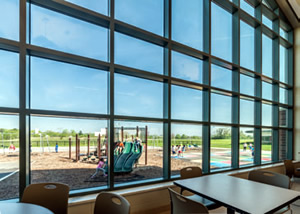
Visual Connections. Transparency between indoor and outdoor spaces stimulates students’ interest in active play.
A good, cost-conscious place to start is applying some simple landscape architectural techniques to create a sense of space and place. One example is the intermingling of planting areas around and amongst the playgrounds to create visual interest and to reinforce spatial intentions. When it comes to benches and tables, less is more. Commercial-quality products that are attractive and durable do a better job of meeting expectations than a higher number of lower-quality products. Even the small addition of a walking bridge over a rain garden creates an exciting place for students to engage in the learning process. The simple observation of the changes in the seasons heightens students’ experience of space, time and the natural environment.
More dramatic options include the development of large outdoor learning areas, including interior courtyards with ponds and natural spaces that allow for the observation of controlled experiments and displays. Many schools have successfully incorporated outdoor amphitheaters with large group seating, student art gardens and campfire-like meeting areas. These spaces create a sense of otherness and a temporary removal from the typical activities of the school day.
Focus on the environment
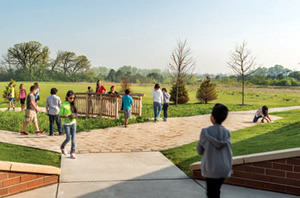
Rain Garden. Creating outdoor learning areas such as this rain garden turns the landscape into a teaching tool and sparks dialogue regarding the natural environment and our place amongst the plants, insects and animals.
Sustainable design is another issue at the forefront of educational facility design, and one that fits perfectly with the creation of dynamic outdoor spaces. Students are becoming more aware of environmental issues than ever before. The use of outdoor interpretive signage to point out natural features, including plantings and wildlife, is an inexpensive way to turn the outdoors into a living, breathing classroom. Detention basins, rain gardens and naturalized areas all provide an opportunity to see nature at work.
While connections to the environment are important, security is also an increasingly expressed concern. Playground fencing options range from complete security for urban areas to being more about setting boundaries in rural areas. In all cases, playground monitoring stations must have visual access, be comfortable and encourage students to approach the adults in charge.
Addressing accessibility
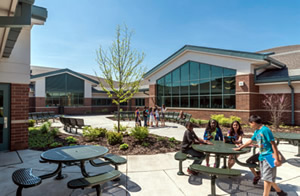
Tricked Out. Commercial-grade tables and bench seating provide students with outdoor environments on par with those found in their everyday lives.
While quality design and sustainability are two top-of-mind issues in school design, recent changes to accessibility enforcement have changed how schools approach surfacing their play areas. Two years ago, the Department of Justice announced that it would investigate, not just record, all ADA-related complaints. In regards to playgrounds, this provides school districts with the extra incentive to make sure that their playground surfaces are established and maintained to be accessible.
While a playground surface such as pea stone provides excellent drainage, acceptable impact attenuation and is long lasting, it is not accessible. Wood fiber is accessible if properly maintained, but this requires weekly or even daily upkeep. The acknowledgement of the cost of such upkeep has increased the interest in two options that previously seemed too costly for the typical schoolyard: the use of poured-in-place synthetic surfaces and rubber tile playground surfaces.
Both poured-in-place surfaces and rubber tile surfaces offer excellent maintainability. When long-term maintenance is taken into consideration they become increasingly cost effective alternatives. However, getting the best value requires a proper understanding of each product’s strengths and weaknesses.
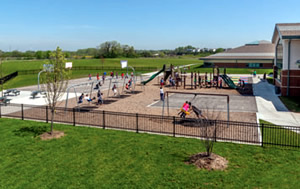
Variety of Surfaces. Playgrounds utilize a variety of surfaces to support different types of play, enhance accessibility and to promote student safety.
The poured-in-place synthetic surfaces provide excellent impact protection for falls from playground equipment. The flexibility of their installation makes them appealing for use around playground equipment with multiple posts and ground attachments. In addition, repairs to the poured-in-place surfaces are relatively easy. The firmer, more resilient rubber tile surfaces provide an outstanding surface for open play areas, where they offer optimal support for running, jumping and tumbling. As one young gymnast recently commented, “The tiles are great for practicing floor routines.”
Next Generation schools are changing inside and out. If embraced, the trends impacting outdoor learning environments offer many opportunities to create cost-effective, long-lasting solutions. The next great educational experience for students of all ages is closer than you think. Just look outside.
This article originally appeared in the issue of .