No Longer a Lofty Goal
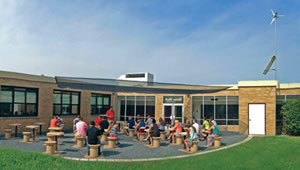
PHOTO © LARSON & DARBY GROUP
As architects, school board members, administrators and parents, we are committed to maximizing the impact we can have on the environment in which our students learn. We design schools that let the sunshine in, are full of clean air, where students and teachers can communicate effectively, use energy and resources efficiently, and are much less wasteful. We design schools for healthy, high-performing kids because we believe that the environment our students learn in plays a very significant role in their success — academically, emotionally, socially and culturally.
Best practices used in sustainable school design include: using white reflective roofing materials or actual green roofs, specifying high efficiency mechanical equipment and completing the comprehensive commissioning process, selecting more locally based or produced building materials and recycled building materials, and installing occupancy sensors, low-flow plumbing fixtures and efficient lighting systems. These are all great areas on which to focus our sustainable efforts, and they almost always pay solid dividends to the school district as well as to the community. There are numerous districts that have employed these sustainable measures successfully.
More recent trends that we have seen in our region include the increasing use of geothermal mechanical systems. There are currently referenda on the spring election ballots to fund some of these efforts. If the payback timeframe drops down closer to 10 years rather than the 20-plus year range, these systems can make a great deal of sense.
In the past couple of years, there has also been a significant push towards what many of us call “low hanging fruit.” One of those is the replacement of existing lighting fixtures with new LED lighting fixtures. The LED fixtures are continuing to come down in cost and are a very attractive opportunity, as the payback is also reasonably quick. Additionally, there have been some grant and incentive programs to assist school districts with the initial investment.
Another recent trend has been the use of alternative energy products such as solar panels and wind turbines. Although, these alternative energy sources have not quite yet taken over to provide complete and reliable power to an entire school facility, they do supplement the building power needs significantly. Waltham School District 185 in Utica, Ill., has two 70-foot-tall wind turbines and a small solar panel array installed at Waltham Elementary School. Larson & Darby Group was recently informed that these alternative energy systems were accounting for approximately 50 percent of the buildings electrical power usage. Also, these energy sources are connected directly into the main science classroom and have been incorporated into the curriculum. The projects were partially funded through a state energy grant program.
Along those same lines, Sycamore Unit School District 427 recently repurposed the old, unused courtyard at the high school. The courtyard is now home to a number of useful and interactive areas:
- an outdoor classroom that is fully accessible and seats 32 students with a seasonal canopy for shade and glass windows converted to white boards;
- a quiet reading area landscaped with a small fish pond and set up to attract a variety of birds;
- an outdoor area for students to gather and eat lunch;
- a babbling brook that cycles the water through medium-sized rocks gathered from local farmland;
- a large steel sculpture of a Spartan (the school mascot) on a horse; and
- a small wind turbine and solar panel cell.
The project was funded with a grant from the Sycamore Education Foundation and completed with student and staff labor during the summer of 2014. Another unique feature that is in the process of being completed is tying in the power that is being generated by the small wind turbine and solar panel to a set of lockers that will function similar to storage lockers you see at a train or bus station. The units will be lockable and a student can pop in a couple of quarters to and then put their personal electronic device inside to charge during class.
Sustainable design is no longer the lofty goal it once was, in fact, this approach is now becoming the norm and is consistently being incorporated into all facets of building design. As time passes, sustainability will be an inherent application of what we have always done instead of a green trend.
This article originally appeared in the issue of .
About the Author
Stephen Nelson AIA, LEED-AP, is director of Educational Architecture with Larson & Darby Group, vice president of the Sycamore (Ill.)SD427 Board of Education and serves on the Kishwaukee Division Exec Board and the Service Associates Executive Board of the Illinois Association of School.