Blue Cleaning Saves Green
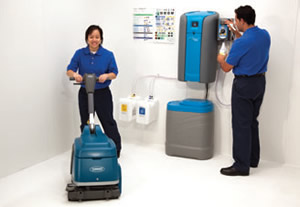
Tennant’s effective and environmentally friendly products have helped revolutionize the way a wide variety of institutions polish and scrub their floors.
For colleges and universities, cleaning with electrically activated water (EAW) has evolved in recent years from an intriguing concept to a proven, very deployable alternative to cleaning with conventional packaged chemicals. In its early form, EAW emerged as a disruptive technology that electrically converts water into a solution that cleans effectively, reduces the cost to clean, improves safety, minimizes the environmental impact of cleaning operations and reduces chemical-related tasks, costs and concerns.
In 2007, broad adoption of EAW truly began when Tennant Company launched ec-H2O technology as an “on-board technology” for hard floor scrubbers. Since then, Tennant has sold more than $600 million worth of scrubbers to a wide array of institutions.
As adoption escalated, customers in the education market began looking for EAW solutions that would allow them to clean more surfaces such as glass, tables, stainless steel and carpeting. From there, the next generation of on-site EAW generators emerged. The early on-site generation EAW systems offered high cleaning solution productivity rates. But they were large, had only a cleaning output and required centralized filling. As a result, these EAW systems were exceptionally effective for cleaning large facilities, but were not practical for broad-scale adoption across university campuses.
Aramark, a global services company that provides facility management and building services to colleges and universities throughout the U.S., recognized the potential for EAW early on. The company identified EAW as a core technology for achieving cost savings, campus safety and sustainability goals at the schools it served.
“The results (using EAW technologies) were so compelling that we formalized our approach and now call it Blue Cleaning,” says Matt Judge, senior director of innovation and expertise for Aramark.
“We are not making incremental improvements or taking small steps toward cost reduction, safety and sustainability goals,” notes Judge. “Our Blue Cleaning processes and the EAW technologies we are deploying allow colleges and universities to make huge leaps forward.”
www.tennantco.com
This article originally appeared in the issue of .