Wright State University Awarded a $7.5 Million Ceiling Increase to an Existing Contract With the U.S. Air Force
 DAYTON, OH – The Wright State University Research Institute (WSRI) has been awarded a $7.5 million ceiling increase to an existing contract with the U.S. Air Force. Additionally, the contract has been extended by three years to accommodate the additional research, should the research funding be available.
The award goes to WSRI’s Remotely Piloted Aircraft (RPA) Program to continue collaborative research for the Air Force Research Laboratory’s 711th Human Performance Wing’s “Interactions with Semi-Autonomous Remotely Pilot Aircraft (RPA) Program.”
Extending the existing agreement (originally a $5 million award in 2011) enables researchers to continue their efforts to enable a single operator to control multiple unmanned air vehicles (UAVs), and by doing so their research will aid the evaluation of advanced controls and displays in semi-autonomous, remotely-piloted aircraft. The WSRI research team is led by Chief Engineer Dr. David Gross.
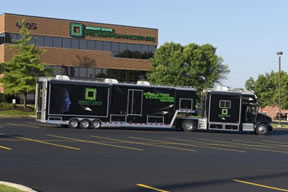
Gross’s RPA team conducts much of its work from the Wright State-owned Mobile Test & Evaluation Center (MTEC), a million dollar, computer-stocked, state-of-the-art tractor trailer which travels to various sites to conduct simulated and live unmanned air vehicle flight test experiments.
The contract extension will continue the investigation of: advisory, caution and warning systems; advanced communications suites; tactical situation displays; manual flight control; system and sub-system pages; electronic checklists; primary flight displays; advanced route planners; and vehicle handoff.
The upward trajectory of UAV performance today calls for the supply to keep up with the demand, underscoring the need for a significant decrease in the operator-to-system ratio, i.e., increasing system capability and supporting the multi-role control station to allow a single operator to manage multiple RPAs.
“The contract renewal is another example of how WSRI’s commitment to create innovative solutions in remotely piloted aircraft supports the Air Force Research Lab and its mission,” says Jason Parker, WSRI director. “Dave Gross’s team has done a phenomenal job leveraging the wealth of human capital at the university and the institute to advance this very specialized research.”
“In four years working with AFRL’s 711th Human Performance Wing, we have gained enhanced knowledge of the human performance for controlling and interfacing with unmanned aircraft, and we’ve made many advances in the technologies, methods, and techniques sought,” said Gross. “We have demonstrated the ability for UAVs to provide significant surveillance and observation data.”