Battling School Construction Delays
- By Michael Fickes
- 09/01/15
PHOTOGRAPHY BY FANNING HOWEY
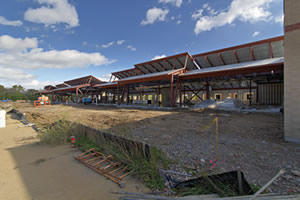
A $23-million high school in Wyoming slated to open in mid-January has been delayed for two months. The contractor on the project blamed weather, change orders, design changes and other factors.
The district superintendent disputed the contractor’s explanation.
In mid-August, a new $66.6-million Virginia high school pushed back its completion date for a third time, blaming construction delays. Neither the school district nor the contractor cited specific construction problems. The contract requires the contractor to pay a $5,000 penalty for every day’s delay in failing to substantially complete the project by May 31 of this year. School officials and the contractor are planning to negotiate actual penalties at some point in the future.
In the school construction world, on-time performance means on-time pay and schools ready to welcome students on the first day of the semester. That’s what school superintendents expect, and what contractors, subcontractors and suppliers try to provide.
But there is nothing easy about achieving it. Designing and constructing a new school and opening it on time requires moving tremendous amounts of cash from school district coffers to design firms and construction companies, which then pay their vendors and employees.
When construction stops — for whatever reason — so does the flow of money, which often creates problems requiring more money.
The projects that hesitate or pause now and then but never quite come to a halt typically boast skillfully written schedules managed by shrewd, strong, no-nonsense construction people who can spot and squash a developing problem weeks before it can cause any mischief. Here are some ways to avoid delays.
It always takes longer
The work of building a construction schedule starts before an architect puts pencil to drafting board. “There are factors that we can control, and so we plan accordingly,” says Brad Skillman, president of The Skillman Corporation, which is based in Indianapolis and has offices across the Midwest. “As designers and builders, where we get delayed most often are in the intangibles that we can’t control.
“Acquiring building permits and getting design approvals are two areas that are difficult to control. We might expect a turnaround time of 45 to 65 days for either of these tasks, but we’ve had instances where it has taken four or five months.”
PHOTOGRAPHY BY FANNING HOWEY
Skillman tries to anticipate permitting and design approval delays and lengthens the schedule to accommodate them. “If we know it will take two months, we put four months into the schedule,” he says.
Even after thinking ahead and making decisions to protect the schedule from delays, the process can go awry. “We’re working on a $2.5-million renovation of the third floor of a high school, and we probably won’t have final permits before the space is occupied,” says Garry Webb, director of construction administration with Indianapolis-based Fanning Howey, an architectural firm that specializes in educational facility design. “We’re working with temporary permits. Some jurisdictions have permit expeditors who help facilitate tasks that can get bogged down in the bureaucracy.”
Another delay that designers and contractors can’t control involves infrastructure improvements. The county utilities supplying gas and primary power might blow the schedule. The telecom company installing fiber optics might run into delays as well.
Keep the problem of infrastructure delays in mind and allow plenty of time for infrastructure improvements — the crews that will do that work cannot always control their schedules.
Overcoming delays
No matter how good the planning, delays inevitably crop up. Some are inexcusable, and some are excusable.
Contractors can cause inexcusable delays by failing to make timely materials acquisitions, for instance. Excusable delays are beyond a contractor’s control. A spate of bad weather may cause an excusable delay.
“Resolving Problems and Disputes on Construction Projects: Tackling Contract Performance Delays,” a paper authored by attorneys from the firm of Sutherland Asbill & Brennan LLP notes the legal pitfalls that owners and contractors must navigate when delays occur.
Not all of their observations are intuitive. For instance, the authors say: “Many contractors make the erroneous assumption that they are not liable for an owner’s delay damages unless the contract contains a liquidated damages provision. To the contrary, an owner who does not include a liquidated damages clause in the contract will generally be entitled to his actual damages if they are foreseeable and can be proven with reasonable certainty.”
That said, the components of on-time delivery include experienced managers and staffing, communications and pre-installation meetings, giving consideration to the schedule in design and early material acquisitions.
Getting on the same page
To move forward smoothly, owners, architects, contractors and subcontractors need to have the same ideas about what will happen now and next.
“We work with the architect in making decisions about design with the goal of helping to avoid redesigns and change orders,” Skillman says. “To do that, we need good construction documents. A contractor can put a better number on a clear construction document. Ambiguities make it more difficult.”
Webb agrees, noting that it is important to define decision-making processes across the board before projects get under way. “We conduct an Expectations Meeting in the construction document phase,” he says. “We set up problem-solving roles and procedures. Who is the owner’s representative? What level of decision can that person approve without having to take it up with the school board?
“What cost threshold can that person approve without going to the board? I’ve seen reps that can approve $20,000 and others that have to ask the board for $1,000.
“You can work within any system as long as you understand what the system requires up front.”
Experienced people
Does anyone really need to be told to make sure that experienced people are running things on a major construction project?
Unfortunately, yes.
“I’ve seen a trend developing in the form of a gap between educated construction pros and laborers,” says Webb. “The education gap is growing, and there is a real shortage of skilled laborers, perhaps because of a lack of training.”
Observers also note that the long construction recession saw experienced laborers move on into other fields to find work, further limiting the skilled labor pool.
PHOTOGRAPHY BY FANNING HOWEY
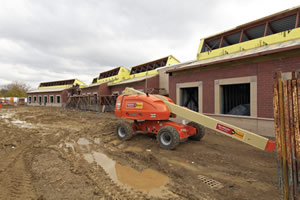
Webb describes one small project that he, as the construction administrator, was monitoring. It was a small, 2,000-squarefoot locker room support building with exterior brick masonry. “There was no supervision on site while they were doing the brick work,” Webb says. “They couldn’t get the brick joints to line up. They had to tear down the wall twice and rebuild it three times before they got it right.”
The final work met expectations, but it took too long and used too many bricks.
Pre-Installation Meetings
Fanning Howey typically organizes pre-installation meetings around specific tasks. “Before installing windows, for instance, we mock up a window installation and ask the installer and manufacturer to sign off on it,” Webb says. “Then we go over every element of the installation at the meeting. By the end of the meeting, everyone understands and agrees on details demonstrated in the model. This is the right anchoring; this is the right flashing. These details then become the basis for reviewing all of the window installations in the building.
“When new laborers come in, we review the current installation models. We do this for windows, steel, masonry, and so on.”
Design for timely completion
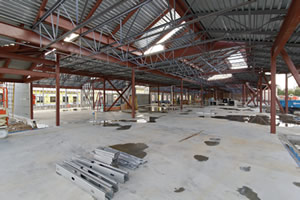
If the schedule is particularly tight, Fanning Howey designers will consider alternative building systems. “Depending on the region and the location, a structural steel framing system will go up faster than a masonry bearing system,” Webb says. “A structural steel framing system requires exterior masonry walls. If you do not use those exterior masonry walls for load bearing, you are, in effect, creating two structural systems. However, a masonry load-bearing system will require a longer construction schedule, particularly when used in colder climates. You have to keep these types of factors in mind when making scheduling decisions.”
Staff up
Fanning Howey assigns a number of hours to each task on the construction schedule and expects contractors to staff up to ensure the work doesn’t take longer than the schedule allows. Suppose a particular task calls for 200 hours. Depending on the schedule, the contractor might assign five laborers for a week — five times 40 hours equals 200.
Link material acquisitions to the schedule
First- and second-tier subcontractors can cause major delays by failing to order materials in time to meet the requirements of the schedule.
“All Major material acquisitions should be tracked on the construction schedule,” Webb says. “Prime contractors should be required to furnish consummated purchase orders for all materials, and owners should be willing to pay to store materials.”
On one project designed by Fanning Howey, the owner ordered all food service equipment and took delivery months before it was needed. The owner paid for off-site storage space. “Our field inspectors documented that it was stored and that the conditions were acceptable,” Webb says. “So when the time came, the equipment was ready.”
While you can avoid delays due to weather and other uncontrollable problems, you can lay plans to avoid and work around a host of predictable problems.
This article originally appeared in the issue of .