Efficient Pumps Boost Campus Comfort
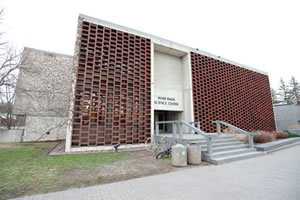
Improved energy efficiency and cost savings were two of
the major benefits St. John’s University received by installing Gundfos MAGNA3 smart circulators.
Cold weather can create
challenges for institutional facility
managers, who often must
choose between meeting occupant comfort
and ever-shrinking physical plant budgets.
A case-in-point is St. John’s University in
Collegeville, MN, which met its heating
goals and saved energy and money thanks
to intelligent hydronic circulators.
The Benedictine school’s Peter Engel
Science Center was heated via baseboards
powered by two primary circulators and four
secondary pumps that serviced the building’s
four wings. Built in the 1960s, the building’s
circulators were oversized and fixed-speed,
so the entire system was operating at 100
percent throughout the heating season.
David Schlumpberger, in charge of
campus HVAC, wasn’t aware of Grundfos
smart circulator technology, which saves
energy by continuously fine-tuning power
consumption, discharge head and flow
rates to meet the heating system’s dynamic
needs. In other words, rather than running
flat-out at top horsepower, the more
energy-efficient option is to start from zero
and ramp up to meet the specific demand.
The four new circulators’ intelligent
technology was able to achieve the necessary
flow rates by expending far less energy.
Estimated annual savings reached $693, and
the project enjoyed a three-month ROI.
“The bottom line is that the MAGNA3 is
sophisticated and capable of doing everything
the old pumps did, only better because
it’s smart,” says Schlumpberger. During one
particularly cold winter, he notes that the
system operated at just 25 percent of the old
pumps, while keeping the building warm.
According to one team member on the
project, this was a huge improvement over
the Science Center’s antiquated pumps.
This is the only manufacturer that offers
a pump that has an integrated logic algorithm
to learn the varying energy-usage
patterns of an application.
For the foreseeable future and beyond,
this university has become immune to the
cold, both temperature- and cost-wise.
www.grundfos.com
This article originally appeared in the issue of .