Environments That Inspire
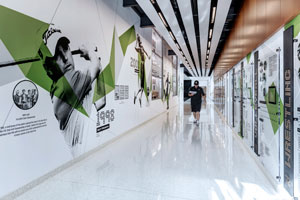
PHOTO COURTESY OF PERKINS+WILL
Educational environments of today are evolving. With state-of-the-art facilitates, the implementation of progressive teaching pedagogies and online high schools, the stakes are suddenly much higher and competitive for new student enrollment and require creative recruitment strategies. Bishop Lynch High School in Dallas has taken a bold and beautiful step towards raising its competitive edge in the game of high school enrollment. In 2012, the campus began a four-year, multi-phase transformation to unify the 50-year-old school into a coherent campus while modernizing the facilities to meet the needs of today’s students, faculty and staff.
During the master planning stages of design, Perkins+Will worked with the client to develop an architectural and interior backbone that would reconnect and unify the campus. This concept became known as “The Way,” an architectural element reaching out to engage the community, while also doubling as a circulation corridor, extending all the way through the campus, from the academics on the west to the athletics on the east, terminating at the stadium. Engaging the entire campus, “The Way” provides a touchstone for students as they progress through their academic life. It is also a place to celebrate the many academic and athletic achievements of the Bishop Lynch students, honor the many who have served the school in teaching and administrative roles, and recognize those who have generously supported the school over the years. “The Way” is not only the physical means to various destinations on campus, it is also a symbolic path for the students’ personal, academic, professional, emotional and spiritual journeys – journeys which begin at Bishop Lynch High School.
To build on the momentum of “The Way”, the Perkins+Will design team worked to develop a school brand that promotes the unique DNA of Bishop Lynch while celebrating the rich history and legacy of its athletes. The brand had to be different; an environment that embraced the school’s heritage while complimenting the overall architectural design of the building, both inside and out. “With more and more students opting out of traditional academic settings and opting for non-traditional virtual settings, exceptional architecture and design become a critical part of our student recruitment and retention toolkit,” says Chris Rebuck, President of Bishop Lynch. “We want to create an environment that boasts a social atmosphere. We want to bring people in to see that professional athletes have walked these same halls. We’re trying to create a vision for what a student’s future can be.”
To understand the full meaning of “The Way,” one simply needs to step inside the newly branded Leyden Arts + Athletic Complex. Faculty, alumni, students and visitors agree the interior environment is much like what you might find at a museum, art gallery or a professional sports stadium. The project has been featured by USA Today and the Dallas Morning News. Both characterized the installation as a “sports museum.”
Floor-to-ceiling murals featuring 13 alumni sports figures from the past adorn what is known as the “Hero Wall” of a two-story, open and airy hallway. Opposite of the Hero Wall, stands a “Sports Honor Roll” wall featuring a total of 14 different sports, including team milestones, individual accomplishments, family sports legacies and current team news. This wall is given further dimension with mural images that are paired with eye-catching graphics denoting the athletes’ names, class years, and inspirational facts about them. The larger-than-life photographs of Bishop Lynch’s legendary athletes are those who’ve graduated and gone on to become elite football, volleyball, basketball, baseball, track and field, and other sports professionals.
Between the murals, a two-story trophy wall includes glass cases filled with championship trophies dating as far back as 1968. Additionally, various panels pay tribute to all of the schools’ sports teams and individual members, including track and field, wrestling, cheerleading, and many more. There’s even a placeholder on the wall for the current graduating class and their team photos — a constant source of motivation and a reminder that they, too, are an integral part of the school. “The people on these walls are real mentors. They’re the living mission of our school,” says Rebuck. “The students, both current and prospective, love it; they’re drawn to it. Alumni are drawn to it, too.”
Realizing such an idea was a collaborative effort between Perkins+Will and Reprographic Consultants. Reprographic Consultants’ grand format printing processes enabled the execution of a complex and layered design that spans multiple spaces with assorted content.
Noteworthy and technical details include:
- Reprographic Consultants achieved a seamless appearance on the “Hero Wall” by using the Epson Eco Solvent roller printer on Dreamscape Suede, which stretches minimally for a smooth, continuous installation.
- The “Sports Honor Roll” wall is supplemented by ½” acrylics boards were second surface printed using the Vuteck flatbed printer with UV ink. The wall is given further dimension with 510 square feet of vinyl wall covering printed with the Epson Eco Solvent roller printer on Dreamscape Suede.
- Gym Banners spanning 5 decades, which commemorate the 215 State Championships achieved during the now-retired facility’s competitive lifespan. The “Legacy Gym” contains 25 banners that showcase life-size athletes. Totaling 570 square feet, the banners were printed with the Epson Eco Solvent printer on Ultraflex Smooth Vinyl and secured on aluminum top and bottom rails.
The result of the collaborative branding effort is a showpiece that not only preserves the history of Bishop Lynch High School, but also conveys the school’s unique heritage and tradition, and has proven itself as a strong recruiting tool to carry that legacy into the future.
Patrick Glenn, AIA, REFP, LEED-AP, An Architect and Educational Planner, Glenn leads the K-12 practice for Perkins+Will’s Southwest Region (including offices in Dallas, Austin and Houston) and serves as the current president of the A4LE North Texas Chapter. his 20 years of academic programming, planning and design experience enables him to build collaborative relationships between educational leaders and design professionals in order to create innovative learning spaces for today’s students. He has participated in more than 90 K-12 projects during his career, totaling over $750 million in construction and impacting more than 70,000 Texas students. He can be reached at [email protected].