O&G Breaks Ground at Grasso Technical High School
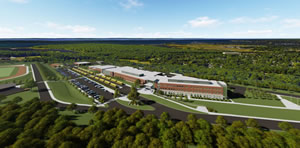
Grasso Tech High SchoolO&G Industries, Connecticut’s largest privately-held construction company, began work on the construction of the new Ella T. Grasso Technical High School in Groton, Connecticut.

O&G was selected as the Construction Manager for the $98.3 million dollar construction project. The project will include construction of a new 220,000 square foot facility on the existing site.  The new school will be built adjacent to the current facility with completion of the new building expected in the fall of 2019 for arriving students, followed by demolition of the existing school where new athletic facilities will be sited on its former footprint. 

Grasso serves students from 24 towns in Southeastern Connecticut with an annual enrollment of over 500 students.  Programs offered at the school include Automotive Technology, Culiary Arts, Electrical, Manufacturing Technology, Plumbing & Heating, HVAC and Information Systems Technology.   The new facility will allow the school to serve 800 students from throughout the region, offering eleven programs in technology and core programs.

Featured

  • Girl Sitting at Library Desk, Using Laptop

    How Campus Design Shapes the Finals Week Experience

    Academic performance is not just about preparation. It is closely tied to how students manage stress, maintain their energy, and shift between work and recovery modes. Much of that is influenced, directly or indirectly, by design.

  • ZeroEyes, Academic Innovators Partner to Provide Safety Solutions

    ZeroEyes, which produces a multi-analytics weapons detection and threat intelligence platform, recently announced a partnership with Academic Innovators, according to a news release.

  • Lawrence Group Announces Three New Hires

    Integrated planning and design firm Lawrence Group, based in St. Louis, Mo., recently welcomed three new staff members, according to a news release.

  • Rethinking K-12 Schools as a Continuous Learning Experience

    Most students move through three or more separate facilities during their K-12 journey, yet the built environments they encounter at each stage have traditionally been designed in isolation, with little continuity in spatial language, learning philosophy, or physical resources. Each new school is a reset with different layouts, learning models, expectations, and ways of moving through a building. The next generation of school design is making the case that the first day of kindergarten and the last day of high school can and should feel connected through common support systems and infrastructure in the physical environment.