Progress in the Heartland
- By Stuart A. Brodsky
- 10/01/17
 We’ve seen progress made in pk-12 schools towards creating more sustainable facilities from building, materials and furnishings design standpoints. For example, while LEED and other sustainable certifications remain aspirational goals for many institutions, their design criteria (certifiable prerequisites and credit strategies) have transformed the basic level of design that schools purposefully choose to incorporate with or without certification. Reducing the use of products that have high volatile organic compound (VOC) emissions is more commonplace, providing better air quality for students and teachers. And international energy codes and other building code criteria have reinforced the importance of targeting lower energy consumption.
While these efforts are notable, it’s important designers and educators alike continue to focus on infusing sustainability into PK-12 facilities. We need look no further than the heart of the Midwest for inspiration. Chiaravalle Montessori and Booker T. Washington STEM Academy — both located in Illinois — are shining examples of how PK-12 schools can go all in on sustainability.
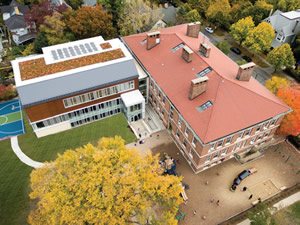
Chiaravalle Montessori, located in Evanston, seized a rare opportunity to construct a sustainable haven of Montessori learning. The 19,000-square-foot new North Wing was designed with a focus on bringing nature inside — 79 percent of the wing’s core learning spaces are lit through natural daylight. A 7kW-roof-mounted photovoltaic array produces more than five percent of the facility’s energy, paired with a green roof that reduces storm water runoff and improves the energy performance of the building. The wing uses a geothermal heating and cooling system that substantially reduces energy consumption. These low energy use strategies helped Chiaravalle secure grant awards from the Illinois Clean Energy Community Foundation and ComEd Smart Ideas program. To make the building a learning tool itself, the wing includes an interactive sustainability dashboard so students can monitor energy use, the performance of the building systems and solar panel data.
This dedication to sustainability resulted in the North Wing earning LEED Platinum certification, a call-out by the USGBC in its annual Top 10 states for LEED listing, and a U.S. Department of Education Green Ribbon Schools award.
Booker T. Washington STEM Academy, found in Champaign, takes sustainability to the next level by weaving it into every element of the design and curriculum. As the first K-5 STEM (science, technology, engineering, and mathematics) magnet school in Illinois, the school incorporates sustainable features that provide opportunities for hands-on, empirically based learning.
A courtyard contains raised planting beds for growing vegetables and a rain barrel for watering landscaping, fostering environmental stewardship and healthy lifestyle choices in students. Bioswale gardens both reduce storm runoff, and provide a habitat in which to observe plant life. Education gardens that surround outdoor classrooms around the school knit the STEM curriculum to the facility and landscape design. Daylighting, geothermal energy and photovoltaic panels are among the additional energy-efficiency elements used that helped earn a Gold LEED certification.
There are no limits to the methods we can weave sustainability in our PK-12 schools. Chiaravalle Montessori and Booker T. Washington STEM Academy prove this. It’s no wonder Illinois was recently named one of the top 10 states for LEED by the U.S. Green Building Council (USGBC).
This article originally appeared in the issue of .
About the Author
Stu Brodsky is motivated by his clients and the students they serve. His career has primarily focused on pK-12 educational design, and he is a member of the CannonDesign's Central Region pK-12 leadership team. Stu values the long-term client relationships he's developed, and opportunities to shepherd projects from inception to completion. He is inspired by creating a legacy of transformative environments with flexibility for future learning scenarios and student growth. Stu is also a requested speaker and board member of several Illinois-based design organizations.