University Restores HVAC System Performance
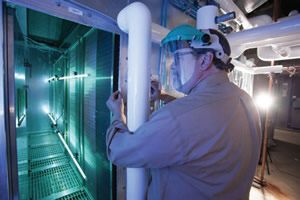
The University of Arkansas achieved better IAQ and less energy consumption in their buildings with the help of UV-C from UV Resources.
When your campus is home to 27,000 students, indoor air quality (IAQ) is of utmost importance. Located in Fayetteville, the University of Arkansas has 100 buildings served by approximately 150 air handling units (AHUs), each designed to condition and filter campus airstreams.
Rick Gragg, HVAC coordinator with the university’s Utility Operations Facility Operation department, has supervised a decade-long mission to improve IAQ by retrofitting campus AHUs with ultraviolet germicidal irradiation. The technology uses light in the ultraviolet-C (UV-C) spectrum to remove biological growth from HVAC/R equipment, ensuring safe and clean air for students and faculty.
Gragg’s experience with UV-C began in 2008, when facilities personnel alerted him to complaints about biological growth accumulation on the air distribution registers in the Health, Physical Education and Recreation Building.
Using this as a test case for UV-C, Gragg had his contractor retrofit the lights on two air handlers downstream of the coil that service the building. He chose the RLM Xtreme fixtureless UV-C lamp system, manufactured by Santa-Clarita, California-based UV Resources.
Over a three-month period of UV-C treatment, measurements revealed a coil pressure drop decrease from nearly 1.0 inch to less than 0.8-inch of static pressure. This 2/10th of an inch reduction meant that the AHU fan didn’t need to strain to draw air through the plenum, providing energy savings and disinfection.
“Once the coil was cleaned and returned to its original ‘as-built’ specification, the system did not need to consume as much energy. As a result, we could lower the brake horse power by 1.311 and save roughly $1,077 in annual energy costs,” reports Gragg.
Convinced of UV-C’s effectiveness, the university has continued to install the units ever since—48 to date—across campus as standard practice. The most recent application involved installing the technology in two air handling units in February 2018.
www.uvresources.com
This article originally appeared in the College Planning & Management March 2018 issue of Spaces4Learning.