The 20-Acre Classroom
- By Rodney Wiford, Stephan Howick
- 03/01/18
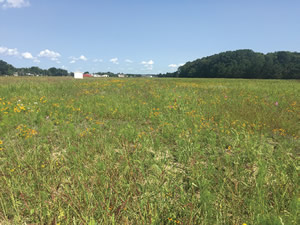 When you hear the word “classroom” what image comes to mind? Maybe it’s traditional rows of desks facing the front of the room. Or perhaps you picture a flexible environment, fit with moveable furniture and integrated technology. But no matter how progressive your idea of a classroom is, you may still be thinking inside the box—because at the new Northwood PK-12 School in Northwood, Ohio, a classroom doesn’t have to be “inside” at all.
Redefining the Classroom
Science teachers at Northwood Local School District expressed a desire for a different kind of learning space, one where students of all ages could study nature through hands-on activities. The school chose to access a 20-acre parcel of land that they owned. A team of community partners, teachers, administrators, school planners, and volunteers have implemented a plan to restore the land to a warm season grass habitat. With the site adjacent to a city park, they conceptualized a 0.7 mile trail to link with the park and to pass by a creek that runs through the site.
The site is now home to a multitude of native plants and flowers, butterflies, and migratory birds, and is used by the school for a variety of project-based learning activities. Northwood students examine the diversity of plants, observe the resident wildlife, and study their classroom’s unique ecosystem. Middle school students are even conducting annual observations of the plant communities to document how the prairie changes over time for future generations.
The creation of the prairie also provides students with a valuable lesson in sustainability. Because the creek that runs through the classroom feeds into Lake Erie, the conversion of the land from agricultural field to native grassland contributes to improved water quality in Lake Erie. Learning about this process firsthand helps students to develop a passion for sustainability and its applications. Access to the creek also allows students to conduct water testing and to observe local marine life. The project’s positive impact on the environment and the education of students has even led to the program receiving funding from the Great Lakes Restoration Initiative and a number of other community partners.
Making Your Own Outdoor Classroom
When planning your own outdoor classroom, choosing the right site is critical. Not every outdoor classroom needs to be 20 acres, so think about how large of an area you are willing and able to maintain. Once you start this process, nature will work to restore the site to its natural state, which in Northwood’s case is hardwood forest. In order to anticipate the maintenance effort needed for your site, keep the natural cycle of succession in mind when planning your project. To ensure the greatest use of your classroom, it’s a good idea to procure a site that is directly accessible from your school.
When it comes to establishing vegetation, confer with your local parks, Department of Natural Resources, and state Fish and Wildlife Service. The warm season grass seeds that Northwood selected don’t establish quickly, and they may require weed control at the beginning through mowing, herbicide treatments, or controlled burns to help your desired plants compete with undesired ones.
To gain support from your community and appeal to as many stakeholders as possible, advertise the multi-use aspects of your classroom. At Northwood, not only can students use the space to participate in hands-on, project-based learning, but community members can also walk the trails and the cross country team can use the trails as a running course. The natural beauty of Northwood’s outdoor classroom has even made it a destination for wedding photos!
Planning and implementing an outdoor classroom can be a lot of work, but if your district has educators or students with a passion for this kind of space, it is work worth doing. Outdoor classrooms provide opportunities not found anywhere else, and they can help to teach students important lessons about sustainability and the value of the natural environment. So whether you have half of an acre or 20, when considering the learning possibilities associated with your outdoor classroom, the sky is the limit.
Follow Northwood Local Schools’ outdoor classroom on Twitter @nhsoesl.
This article originally appeared in the School Planning & Management March 2018 issue of Spaces4Learning.
About the Authors
Rodney Wiford, AIA, REFP, LEED-AP BD+C, is an architect and project manager for Fanning Howey, a national leader in K-12 school planning and design.
Stephan Howick, RLA, LEED-AP BD+C, is a landscape architect with Fanning Howey, a national educational facilities planning and design firm.