Missouri S&T Announces Fitness Center Expansion

Missouri University of Science & Technology (Missouri S&T) in Rolla, MO, recently announced an expansion project to their existing fitness center. The expansion will increase the building size from 6,400 square feet to 16,600 square feet, and provide more space for weights and other exercise equipment.
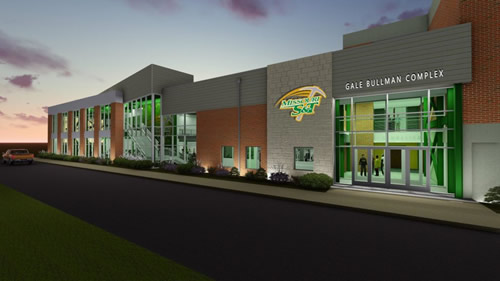
Missouri S&T

Alongside an increased amount of exercise equipment for students, the fitness center expansion will also feature a multipurpose exercise room, new exercise flooring and wall coverings, and a larger area for cardio equipment.

Work on the expansion is set to begin in the summer of 2018 with DeWitt and Associates, Inc. of Springfield, MO, managing construction. The expanded facility is slated to open in April 2019.

Featured

  • A digital silhouette works at a computer, immersed in a glowing, interconnected world

    How Will AI Transform Learning Space Design?

    For years, higher education has designed learning spaces around technology as a tool for display, capture, collaboration, and connectivity. AI changes that equation.

  • Colorado School District Breaks Ground on Unified PK–12 Campus

    The Haxtun School District No. Re-2J in Haxtun, Colo., recently announced that ground has been broken on a renovation/addition project that will unite its two schools, Haxtun Elementary and Haxtun Jr/Sr High School, according to a news release.

  • Girl Sitting at Library Desk, Using Laptop

    How Campus Design Shapes the Finals Week Experience

    Academic performance is not just about preparation. It is closely tied to how students manage stress, maintain their energy, and shift between work and recovery modes. Much of that is influenced, directly or indirectly, by design.

  • Can AI Help Build Stronger Communities in Student Housing?

    Student housing success is shifting from operational performance to student experience, with belonging now at the center. A recent 2025 report underscores a growing emphasis on student well-being, community, and engagement, signaling that expectations now extend beyond logistics to ensure students feel supported in their living environments. AI is enabling that shift by reducing administrative workload and giving teams more time to focus on meaningful student engagement.