9-to-5 Flooring
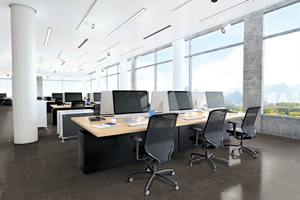
PHOTO © ARMSTONG
Choosing flooring systems for campus administrative spaces requires an adroit balance of factors that include acoustics, function, budget, aesthetics, sustainability, and maintenance. Decision makers can have their hands full, particularly when considering whether to go with hard surfaces or carpets for such spaces.
Finishes in high-profile administrative areas, whether at the university, college, or departmental level, are expected to reflect and exude a certain bearing, such as leadership of an institution. Still, these are working areas that must withstand plenty of traffic. Additionally, administrative areas are not monolithic, or solely an office for a president or dean, for instance, but also consist of sections for staff as well as for leadership, conference and meeting rooms, reception areas, and back-of-the-house spaces.
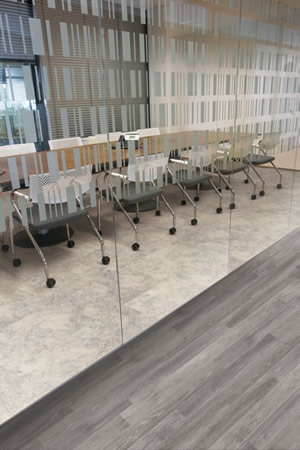
PHOTO © ARMSTONG
Three industry experts recently shared insights about this topic with College Planning & Management: Robert Brockman, channel marketing manager at Armstrong Flooring; Wendell Hadden, vice president of Education at Interface; and Jonathan Stanley, vice president, Education Strategic Accounts, at Tarkett North America.
Each addressed flooring for today’s campus administration areas and the best ways to respond. Attractive flooring comes in various forms, yet each material has pros and cons that need to be weighed.
Weighing Pros and Cons
For example, carpet is popular for such spaces, Armstrong’s Brockman acknowledges, but issues such as cleaning, water resistance, and durability point instead, in his view, to “resilient, non-fibrous, and stain-resistant flooring options.”
Brockman urges decision makers to consider factors such as: “Durable finishes that resist staining and protect against scuffs, scratches, and heavy foot traffic; colors and patterns that disguise scuffs,” and materials and finishes that resist “indentations from chairs, desks, and other heavy objects.” Additionally, a product’s sustainability and indoor air quality characteristics are two other key points to consider. Brockman says new luxury vinyl tile (LVT) options with no-polish surfaces, vinyl as well as tile made from renewable ingredients, heterogeneous and homogeneous sheet products, and hardwood each can meet the needs of campus offices and administrative areas with distinction, economy, and aesthetic appeal.
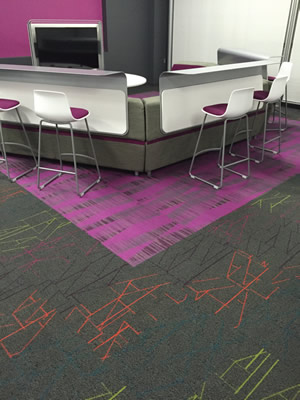
PHOTO © ARMSTONG
Vinyl composition tile is a frequent choice, says Interface’s Hadden, but requires waxing and wax strippers. LVT, on the other hand, requires less maintenance, but the key is that the LVT product prevents scuffing and reduces sound impact, as does a product with acoustic backing, according to Hadden. Additionally, carpet tile can provide solutions for administrative spaces. He says carpet tile’s benefits include “reducing sound transmission, providing underfoot comfort, strengthening a campus’ branding and design, and providing flexibility to update and refresh as needed.” He points out that such flooring can “improve sanitation, as stiff fibers can capture more than 90 percent of dirt and debris.”
Stanley at Tarkett says that while there are many things to consider for such spaces, “generally the criteria revolve around acoustics. Soft-surface flooring is the primary choice.” Yet, things are changing, with “administrative areas now being blended into campus life,” he explains. Such spaces enable easier access and ad hoc engagement for students and others in number, and thus call for great resilience in addition to acoustical qualities.
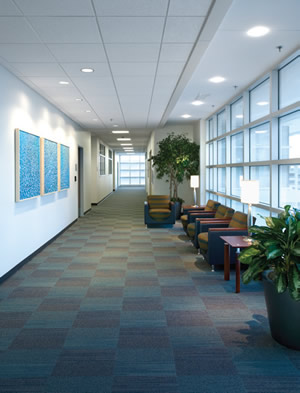
PHOTO © ARMSTONG
Asking Good Questions
When weighing the pros and cons of any potential choice, it’s important to ask good questions. For Stanley, that means “starting with how and why a space would be used...also, who would be using the space.” Another way to find answers is by “looking at similar areas on campus and measuring their results.”
Tarkett asked questions in a recent survey of university facilities managers and design and construction professionals, with answers pointing to “life-cycle costing as the number-one driver,” explains Stanley. He says the company is preparing a related tool that will give campus pros perspectives into “overall ownership costs versus the focus of first cost. This is an immediate need with deferred maintenance budgets reaching into the billions.”
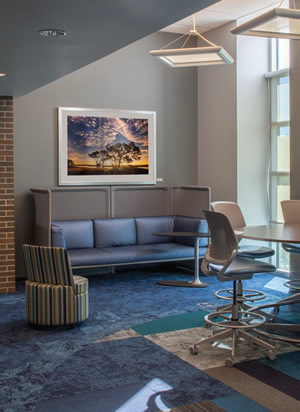
PHOTO © INTERFACE
Brockman proposes a series of questions, including, “What is most important to you and your occupants? Is it durability, performance, design, cost, maintenance, environmental or even health considerations? What is the volume and type of traffic expected in that area? Do you have specific wayfinding needs or a certain school color or palette? What are your maintenance requirements? Are there any special installation requirements? When and how quickly does it need to be installed? With what substrate are you working? Does the space need to reflect the elegance and status of the upper administration of the institution?” He says the answers will help decision makers hone in on the best options.
Hadden also points to questions of daily use, explaining, “it’s important to take into account the amount of traffic the space will receive, the office area arrangement, the flow of traffic in the space, and any other existing conditions that may be impacted by the flooring; in other words, office noise.”
Providing Additional Insights
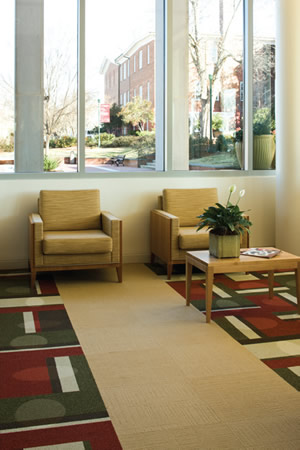
PHOTO © INTERFACE
There is also the question of balance. As Hadden says, “Oftentimes, the best approach isn’t an either/or, but [instead] an integrated take on the space that utilizes LVT and carpet tile.” His recommendation is essentially about carefully choosing flooring that meets important needs for users: “Take all of a space’s conditions into account and utilize LVT and carpet to transform the area into a space optimized for student and employee wellness and productivity.”
All told, decisions about flooring in such campus spaces require careful and wide-ranging thought. There is a considerable amount at stake. Some final insights:
- “Higher education administrative office floors can be subject to some of the toughest demands for any building on campus,” says Brockman, who adds that making the right investment requires certified installation and a correct, and regular, maintenance regime.
- “Better flooring is an investment in college success and campus sustainability, and it’s of upmost importance to consider the entire lifetime of a flooring system when making a selection,” according to Hadden.
- “Flooring has an opportunity to articulate pride of place and how faculty and students, parents, and donor alumnus are passively and actively engaged,” adds Stanley.
This article originally appeared in the College Planning & Management June 2018 issue of Spaces4Learning.