Massachusetts District Prepares for New High School

The new Stoughton High School in Stoughton, Mass. is on track for its targeted completion date of the 2019-2020 school year, officials confirmed recently. The new high school facility is in the final phases of steel beam construction, and will begin the process of both slabbing fireproofing in the coming weeks.

The new facility will include a three-story academic wing, and a two-story public wing, which will house the gymnasium and auditorium.  The new Stoughton High is being built alongside the old school, which will be demolished upon its completion.
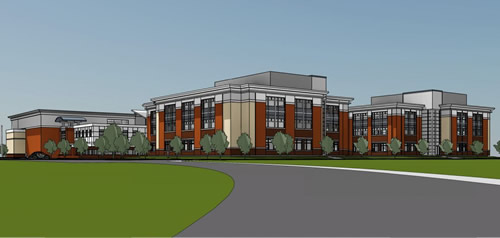
San Benito High School

Drummey Rosane Anderson, Inc is handling all facets of design for the project, with Consigli Construction Management overseeing construction elements.

Featured

  • A digital silhouette works at a computer, immersed in a glowing, interconnected world

    How Will AI Transform Learning Space Design?

    For years, higher education has designed learning spaces around technology as a tool for display, capture, collaboration, and connectivity. AI changes that equation.

  • Wisconsin District Breaks Ground on New Elementary School

    The School District of La Crosse in La Crosse, Wis., recently broke ground on a new elementary school that will consolidate the students and staff of two existing schools, according to local news. Funding for the school comes from a $53-million referendum approved in 2024.

  • Utah Valley University Opens New Engineering Building

    Utah Valley University in Orem, Utah, recently held a grand-opening ceremony for the new Scott M. Smith Engineering Building, according to a news release. The facility is one of the largest engineering buildings in the state at almost 200,000 square feet, and it plays home to the university’s Smith College of Engineering and Technology (SCET).

  • Preparing for the Next Era of Healthcare Education, Innovation

    Across the country, public universities and community colleges are accelerating investments in healthcare education facilities as part of a broader strategy to address workforce shortages, modernize outdated infrastructure, and expand clinical training capacity. These projects, which are often located at the center of campus health and science districts, are no longer limited to traditional classrooms.