Columbus State Breaks Ground for New Culinary Arts Center

A new culinary arts center is in the works at Columbus State Community College in Columbus, OH. The new Mitchell Hall development will serve as a gateway to the college and as an innovative space for students studying hospitality and culinary arts.

The 80,000-square-foot building will feature several teaching kitchens, a functional bakery, spaces for dining and socializing, gardens, classrooms, and a large multipurpose outdoor space. Mitchell Hall is being designed as a space to foster collaboration and socialization among students, and as a space that will work to address issues like nutrition and food insecurity within the community.
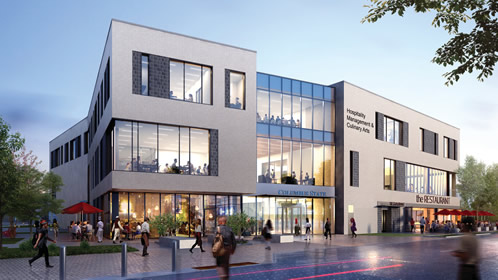
Columbus State Culinary Arts

Ground was broken for the facility in late June 2018. The building will be completed sometime in 2019 with an overall cost of $33 million.

Featured

  • University of Kentucky Receives $150M Gift Toward New Arts District

    The University of Kentucky’s Board of Trustees recently received a $150-million gift from The Bill Gatton Foundation, according to a university news release, to build a new arts district on the campus in Lexington, Ky. The new district will feature a new College of Fine Arts building and a multi-hundred-seat theater, among other amenities.

  • UT System Approves First Funds for New Campus

    The University of Texas System Board of Regents recently approved funds to build the first facility of a new campus in far west Fort Worth, Texas, according to university news. UTA West will serve as a branch of the University of Texas at Arlington and is scheduled to open in fall 2028.

  • NWEA Report Recommends K–12 Natural Disaster Recovery Strategies

    The Northwest Evaluation Association (NWEA), a K–12 assessment and research organization, recently announced the release of a new playbook for schools and communities recovering from extreme weather events, according to a news release.

  • Pitzer College

    Designing for Change in Higher Ed Learning Environments

    Higher education will continue to evolve, and learning environments must evolve with it. By prioritizing adaptable infrastructure, thoughtful reuse, strong energy performance, and wellness-centered design, campuses can create spaces that support learning today while remaining flexible for the future.