Simulation Lab Opens at Yale School of Nursing

The Yale School of Nursing is celebrating the opening of its new Simulation Lab and classroom expansion in West Haven, CT, with facilities designed by architecture, art and advisory firm Svigals + Partners. The $5 million project, led by Svigals + Partners with construction manager Shawmut Design and Construction, has transformed more than 8,000 square feet of space in less than one year, readied in time for the fall semester’s start.
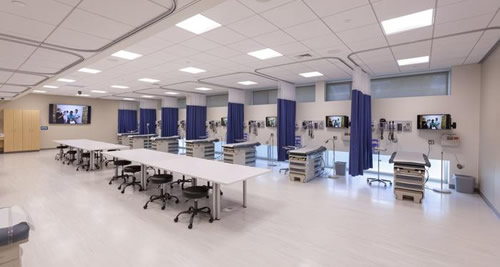
Yale Nursing

The teaching center design integrates two new classrooms with a primary care assessment lab as well as six standardized patient examination rooms. It also offers a one-bedroom apartment layout, used for home-care simulation. Additional upgrades went toward improving the Center for Biobehavioral Health Research and a café on the first floor of the Yale building.

The new, state-of-the-art teaching spaces are designed to "help prepare future Yale nurses to address where health care is going, such as outpatient, disaster, and telehealth care,” says Ann Kurth, dean of the Yale School of Nursing. 

Featured

  • Benson Polytechnic High School in Portland, OR

    Preserving Legacy, Designing for the Future

    As historic academic buildings age, institutions face a difficult decision: preserve and adapt or demolish and rebuild. How do we honor the legacy of these spaces while adapting them to meet the needs of modern learners?

  • Image courtesy of Kahler Slater

    UW–Madison Announces Completion of Morgridge Hall

    The University of Wisconsin–Madison recently announced that construction is complete on Morgridge Hall, a new academic building, according to a news release. The facility opened September 3 at the start of the fall semester, consolidating the School of Computer, Data & Information Sciences into a single facility for the first time.

  • Pitzer College

    Designing for Change in Higher Ed Learning Environments

    Higher education will continue to evolve, and learning environments must evolve with it. By prioritizing adaptable infrastructure, thoughtful reuse, strong energy performance, and wellness-centered design, campuses can create spaces that support learning today while remaining flexible for the future.

  • A digital silhouette works at a computer, immersed in a glowing, interconnected world

    How Will AI Transform Learning Space Design?

    For years, higher education has designed learning spaces around technology as a tool for display, capture, collaboration, and connectivity. AI changes that equation.