Campus Farm Coming to Bucknell
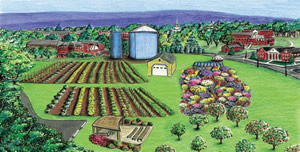
ILLUSTRATION © ADRIENNE BEAVER/BUCKNELL UNIVERSITY
Six years ago, Bucknell University in Lewisburg, PA, planted a seed. That seed became a garden. And soon, it will grow into a farm.
Bucknell President John Bravman announced last winter that the university will establish a five-acre farm on a grass-covered hilltop on campus, providing fertile ground for academic connections, sustainable food production, student life and wellness, and community engagement.
The Bucknell faculty and staff behind the project describe it as a natural extension of the Lewisburg Community Garden in downtown Lewisburg, a collaboration between the university and the borough begun in 2012 to address local food insecurity. Last season, the garden donated 3,800 pounds of produce with a market value over $10,000, and provided ample opportunities for handson student projects and service-learning.
A Cornucopia of Uses
The opportunities, as the organizers see them, are almost endless, and include everything from long-term research projects to locavore dining to outdoor music and arts performances. To help get them up and running, the university hired Jen Schneidman Partica, who was working as the part-time community garden coordinator, as its first farm & garden coordinator. Partica envisions the farm offering “opportunities for research not only in the natural sciences, but also in the social sciences and humanities, as economic, cultural, and political factors impact how we grow and access food.”
Farm organizers have heard from 45 professors from all three of Bucknell’s colleges who want to use the farm in their classes and research, and they plan to consult with faculty to develop more opportunities to do so.
They’re hoping to deepen and extend the sort of experiences that students like Avery Snyder ’18 have had through the community garden. A longtime student worker at the garden, the biomedical engineering major also sat on its community advisory board during her time at Bucknell.
“It’s so important to be able to teach people where their food actually comes from, and I think having a campus farm will increase the opportunities for students to work with sustainability initiatives,” she says.
Locavore Dining
In addition to providing educational opportunities, the university also intends to grow food for Bucknell Dining Services—replacing some produce trucked in from afar with organic fruits and vegetables grown right on campus—and to incorporate dining hall leftovers in composting. “Basically, we’ll be closing the nutrient loop—preventing waste from going to the landfill and converting wasted food back into food by reclaiming its nutrients,” says Professor Mark Spiro, biology, another of the project’s key leaders.
Spiro outlined how the farm will grow produce in distinct zones encompassing different expressions of agriculture. In addition to traditional cultivated fields growing lettuce, sweet potatoes, and other veggies, he also anticipates an orchard of fruit trees, as well as an “agroforest” of native, food-bearing trees such as paw paws and walnuts.
The organizers also see the farm as playing a role in creating a holistically healthy campus environment. In addition to healthy, locally grown produce, other features to meet that goal will include walking paths and an outdoor classroom or performing arts space.
The organizers realize that the project won’t blossom into a fully functional farm overnight. They plan to sow their fields deliberately and thoughtfully. They’ve established a 22-member oversight committee of students, faculty, and staff, and this summer will focus on improving the fertility of the soil and planting a few test beds. In the coming year, they’ll be working closely with Bucknell Facilities to design a site that takes full advantage of the hill’s potential.
“It’ll never be fully done,” Spiro says of the project. “There’s so much we want to do with the farm, but we are taking our time to make sure that becomes a true university-wide farm.”
This article originally appeared in the College Planning & Management October 2018 issue of Spaces4Learning.
About the Author
Matt Hughes is assistant director of Communications for Bucknell University.