A Glimpse of the Future of Educational Facilities
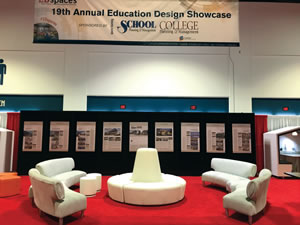
Annual Education Design Showcase

Grand Prize winners and projects that received Honorable Mentions in School Planning & Management’s and College Planning & Management’s 19th Annual Education Design Showcase were the featured attraction in one of the lounge areas of the EDspaces Conference & Expo.

Approximately 2,300 professionals who design, equip, and manage the creative learning environments in our nation’s schools and higher educational institutions gathered in Tampa, Fla., Nov. 7 through 9 for this year’s EDspaces Conference & Expo. The Education Market Association, host of the event, says that attendance has increased by more than 10 percent each of the last two years.

In addition to having the opportunity to visit with more than 200 exhibitors (56 of which were new this year) and experience their offerings of educational furniture, equipment, fixtures, and services, attendees could choose from more than an offering of 60 EDsessions that were certified for continuing education credits. There were also two plenary sessions on creating educational environments for 21st Century Learners and several tours of both PreK-12 and higher education facilities.

If you are curious about new ideas, furnishings, equipment, and products to help create innovative educational spaces, this is one of the conferences you should consider attending. Next year, the conference will be held Oct. 23 through 25 in Milwaukee.

Changes in Our Print Publication Schedule

In 2019, School Planning & Management will begin publishing 8 issues per year—combining the January/February, April/May, July/August, and November/December issues. The January/February issue is scheduled to mail around Feb. 13 and will include our annual Facilities and Construction Brief.

This article originally appeared in the School Planning & Management November/December 2018 issue of Spaces4Learning.

Featured

  • Rethinking K-12 Schools as a Continuous Learning Experience

    Most students move through three or more separate facilities during their K-12 journey, yet the built environments they encounter at each stage have traditionally been designed in isolation, with little continuity in spatial language, learning philosophy, or physical resources. Each new school is a reset with different layouts, learning models, expectations, and ways of moving through a building. The next generation of school design is making the case that the first day of kindergarten and the last day of high school can and should feel connected through common support systems and infrastructure in the physical environment.

  • Planning with Clarity: Using AI to Make Better Campus Decisions, Not Just Better Designs

    Higher education leaders are being asked to make increasingly high-stakes decisions about campus facilities amid greater uncertainty than ever before. Social and economic pressures, shifting enrollment, and evolving learning models compete with growing deferred maintenance needs to strain even the most robust infrastructure budgets.

  • Virginia Tech Tops Out New College of Engineering Building

    Virginia Tech in Blacksburg, Va., recently celebrated the topping out of Mitchell Hall, which will soon stand as the largest College of Engineering building on campus, according to a news release. The university partnered with Skanska on the 285,500-square-foot facility, which has an expected completion date of winter 2028.

  • Children walking along bright school corridor with motion blur

    How Next-Gen Design Is Reshaping the Student Experience

    The environments where students learn play a crucial role in shaping their growth in and out of the classroom. By centering design on well-being, flexibility, and purpose, districts can ensure their facilities remain vibrant community assets for many years to come.