New Spartanburg School Recognized for Commitment to Green Building
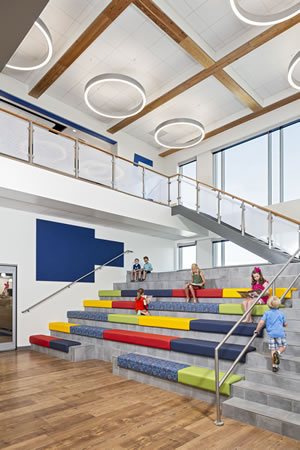 Spartanburg, S.C. – Spartanburg District 7’s new Drayton Mills Elementary School, which opened this past August, earned a Green Globe certification through the Green Building Initiative’s international sustainability assessment, guidance, and certification program. The school is the first educational facility in Spartanburg County and one of very few in South Carolina to receive the certification as a demonstration of commitment to environmental efficiency practices.
To encourage accountability in sustainable design, the Green Globe certification encourages energy conservation, reduced water consumption and the responsible use of materials. As the school’s architect of record, McMillan Pazdan Smith led the sustainability efforts responsible for this achievement.
Educating children, protecting their welfare, and acting as a community ambassador were the primary design priorities of the District, however the team was able to design a facility that meets these important goals while also achieving notable sustainability and green design enhancements.
Drayton Mills Elementary was planned by the district to consolidate two outdated schools into a new, walkable, “neighborhood” school. The new facility is built on a previously developed site with close proximity to the numerous amenities at the redeveloped Drayton Mill. By utilizing a two-story floor plan, the team was able to minimize the building’s footprint on a compact site.
Designed to follow the best practices of 21st-century educators, Drayton Mills’ open-play classroom neighborhoods encourage significant use of daylighting. High efficiency LED lighting is used throughout the school, and in courtyard and parking lot poles. Local dimming, group switching, and occupancy sensors are all key components of the building’s light reduction strategy.
Overall, the facility scored 63 percent of the available assessment points in the Energy Category for the innovative approach to HVAC, including extra attention to the building envelope’s thermal properties and the addition of reflective roofing. Water consumption is carefully mitigated throughout the system, including strategies like well water for irrigation.
Additional sustainable design practices include a trail at the back of the property, a vendor contract for composting kitchen food waste, and a holistic integration of native landscaping elements throughout the property.
McMillan Pazdan Smith has been recognized nationally by Zweig Group on both their “Best Firms to Work For” award and their “Hot Firms” list for the past 3 years. In 2016, the firm won The McConnell Award, the Association for Learning Environment’s highest international award for their educational planning and design work on one of South Carolina’s leading-edge STEAM middle schools.