University of Florida Breaks Ground for New Baseball Stadium

The University of Florida held a groundbreaking ceremony this month for a new baseball stadium, set to host the Gators in 2021. The new park will cost $65 million and expects to be completed in June of 2020.
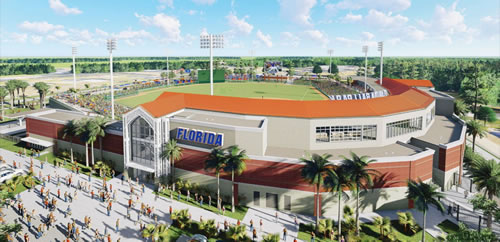
Florida Baseball Stadium

The park will feature a 360-degree open concourse with added shade around the park. The permanent seating will change from 2,400 to more than 4,000. Grass berms and other non-traditional seating will also be available, which the university hopes will help create a more social atmosphere.

The new park will be located on the southwest corner of campus, while the current stadium will be turned into a football training center.

Featured

  • Dallas-Area District Debuts Three New Facilities

    The Duncanville Independent School District in southwest Dallas, Texas, recently held ribbon-cutting ceremonies for three new facilities that resulted from a $170-million bond program passed in 2023, according to a news release.

  • Montclair State University Starts Construction on $120M STEM Building

    Montclair State University in Montclair, N.J., recently broke ground on a new $120-million Interdisciplinary Science Building, according to university news. The university partnered with HoK Architects for the project’s design, and it’s scheduled to open in time for the 2028–29 academic year.

  • TCU Marks Campus Expansion Milestone

    Texas Christian University in Fort Worth, Texas, recently held a topping-out ceremony to mark progress on a major campus expansion effort including four new residential facilities and a five-story parking garage, according to a news release.

  • Wold Completes Geothermal Projects at Two Minnesota Schools

    Wold Architects & Engineers recently announced that it has completed two geothermal expansion projects for Mounds View Public Schools in Shoreview, Minn., according to a news release. The work at Highview Middle School and Irondale High School serves the district’s long-term goal of reducing energy costs and dependency on non-renewable fuel sources, as well as improving building performance.