Virginia Commonwealth University College of Health Professions Opens

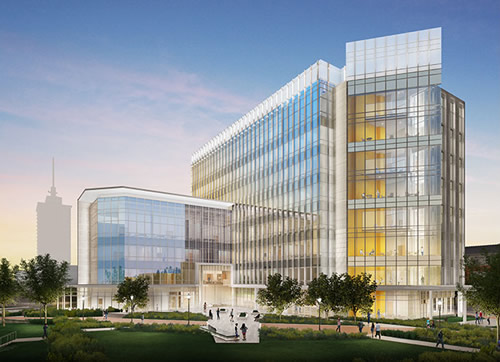
RICHMOND, VA – In 2019, to mark its 50th anniversary, Virginia Commonwealth University (VCU) has opened a new College of Health Professions building, designed by EYP Architecture & Engineering. Bringing all of the institution’s 11 units under one roof, from five different buildings across two campuses, will enable VCU students and faculty to collaborate in ways that have not been previously possible.
VCU Health Professions

Designed for LEED Silver certification, the $87.3 million College of Health Professions building will increase the capacity to grow VCU’s high-demand programs and promote a culture of interprofessional practice that mirrors the future of health care delivery.

The 154,000-square-foot building, which includes a west-facing eight-story wing and a south-facing four-story wing, is equipped with learning laboratories designed for patient simulation and diagnostic technology. Each of the eight floors features formal and informal spaces designed to promote interprofessional education and collaboration among the health professions specialties. Flexible classrooms have been designed for student engagement and distance-learning opportunities.

Featured

  • Building Beyond Simulation: Creating Immersive Ecosystems for Healthcare Education

    Health sciences education is one of the fastest-growing facility types in colleges and universities. The demand for medical, nursing, and allied health professionals is driving the creation and renovation of medical simulation training facilities that provide students with real-world experience through advanced simulation-based learning.

  • How Proactive Maintenance Can Transform Athletic Facilities into Strategic Assets for College Sports

    College athletics is entering one of the most transformative periods in its history. With NIL reshaping financial models and competitive expectations, athletic departments across the country are being asked to do more than ever with increasingly constrained resources.

  • Rethinking K-12 Schools as a Continuous Learning Experience

    Most students move through three or more separate facilities during their K-12 journey, yet the built environments they encounter at each stage have traditionally been designed in isolation, with little continuity in spatial language, learning philosophy, or physical resources. Each new school is a reset with different layouts, learning models, expectations, and ways of moving through a building. The next generation of school design is making the case that the first day of kindergarten and the last day of high school can and should feel connected through common support systems and infrastructure in the physical environment.

  • Georgia State University Opens New Research Tower

    Georgia State University in Atlanta, Ga., recently held a ribbon-cutting ceremony for a new, nine-story, 155,000-square-foot Research Tower, according to university news. Amenities include academic classrooms, a large lecture space, teaching labs, faculty research space, and the uppermost floors reserved for future expansion.